

Farmers on arguably the best soils for growing in New Zealand are revolting against council water restrictions.
Faced with a Hawke’s Bay Regional Council (HBRC) plan to reduce their takes by almost half, water users on the Heretaunga Plains have now decided to unite under one banner. And they’ve already drawn up their own alternative plan for how water would be allocated on the Heretaunga Plains over the next century.
The group is to be called ‘Heretaunga Sustainable Water’ and is being led by orchardists Greig Taylor, John Bostock and three Hawke’s Bay Regional councillors – winegrower Xan Harding, Twyford orchardist Jerf van Beek and Jock Mackintosh. With widespread industry support, the group has $150,000 in donations already in its coffers.
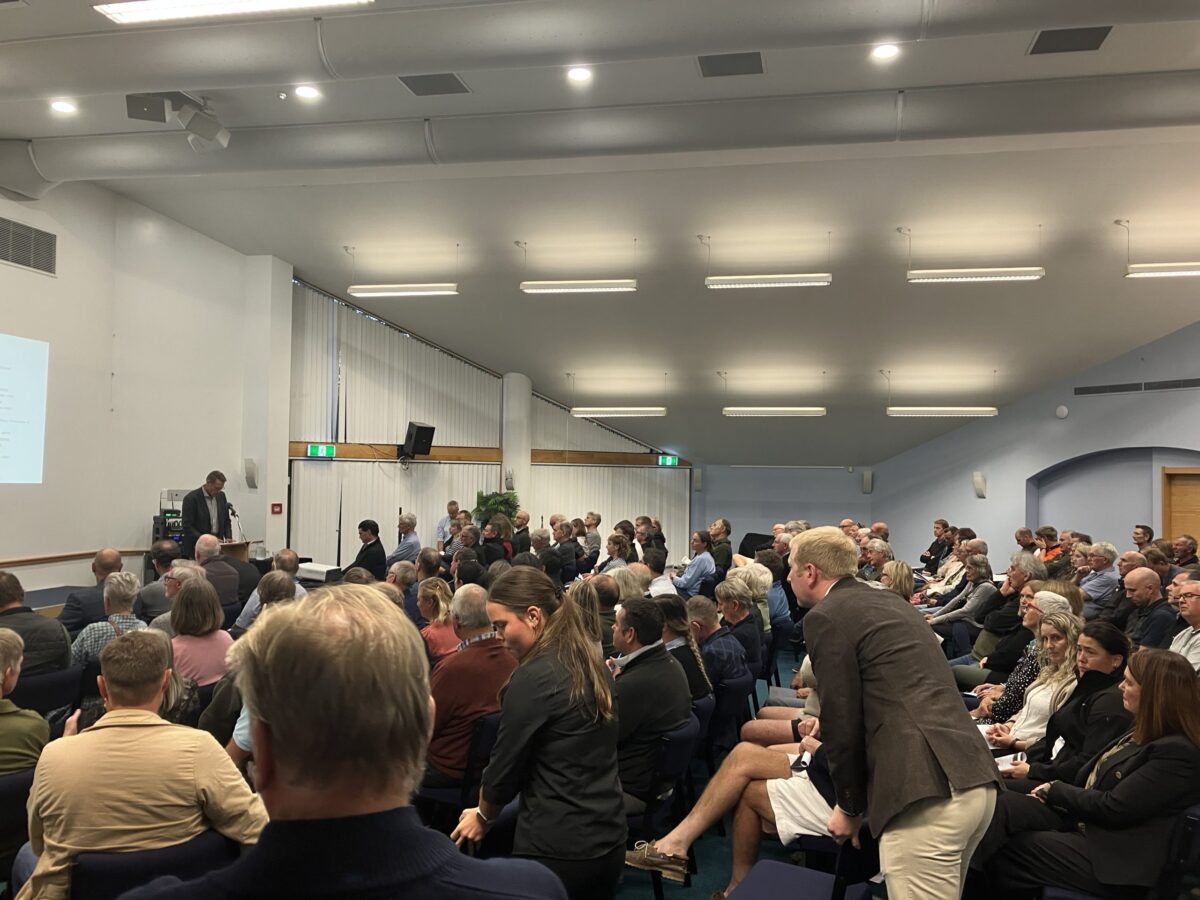
On Thursday night close to 300 people in the horticultural and agricultural sectors of the Bay, and a variety of regional leaders, came together to hear how it would work. Taylor told the meeting it felt like “one of the more definitive crossroads in the history of our region”.
Hawke’s Bay Regional Council and farmers have been locked for roughly five years in an intense fight over a water allocation document called TANK, which took years of discussions before that to draft. The document aims to reduce takes from everyone on the Tūtaekurī, Ngāruroro, Ahuriri and Karamū catchments – including urban water supplies – to just 90 million cubic metres annually. The current take is 160 million cubic metres annually.
Growers say they have a mandate from the Government to double their current exports, but say they can’t do that with such severe water restrictions. Apple orchardists in Hawke’s Bay are already exporting $1b of product annually. “If we want excellence across the board for our region, then we need excellence in water usage. Growers are committed to that. However, what is currently being proposed is not what excellence looks like,” Taylor said.
He said significant pressure from Heretaunga Sustainable Water’s founding members, as well as other industry representatives, saw HBRC issue a late reprieve last Friday to growers. The existing water allocation model will now remain in place until the outcome of an Environment Court hearing, expected in late 2026.
Taylor, van Beek and Harding walked the hundreds at the meeting through what they needed to do next to keep the pressure on.
Van Beek talked the room through a model at Twyford, where dozens of farmers had got together and collectively worked out how much water each of them had, and then decided to share it. It had allowed each of them to avoid take bans during dry months and also lowered the cost of their consents as individuals by grouping their consent into one.
Harding talked about the HBRC-proposed dam at Whanawhana on a Ngāruroro tributary. He said regional council wanted to “get the hell out” of leading the dam’s creation “as soon as possible”, but Heretaunga water users – as a group – could move into that space, with support from mana whenua, Napier City Council and Hastings District Council.
HBRC’s official stance on the amount of water left in Hawke’s Bay to set aside for growth for horticulture and viticulture is that there is no more. The council says if it doesn’t reduce the take from the Heretaunga aquifer, it will have dire consequences on the environment.
HBRC manager policy & planning Nichola Nicolson told Local Democracy Reporting all parties had agreed at the beginning of the TANK process the aquifer was over-allocated. “That’s not disputed. But when people walked away from the table and perhaps realised what it would mean for their business that’s when the collaborative approach dissolved somewhat,” she said. “The need to lower the water take is not disputed, what is disputed is how fairly the available water is allocated.”
Nicolson said often water takes were less than the allocation and the council had based its new figures on actual water use. While the TANK plan on the one hand was trying to claw back “over allocation” (the allocation on paper, not the actual use) it set up several pathways for introducing additional water in the system.
The council’s manager of consents Paul Barrett said some people were upset with the plan because of future development plans they might have had. “There are three factors the plan sets up to look at. One is how much water they actually used in a 10-year reference period. Another is how much water their consent currently provides for and third is crop water demand estimate based on their crop type and the area they are in … At the current level of extraction in dry conditions, something like 1000 litres a second is depleted from the Ngāruroro River.”
Nicholson said if the TANK plan didn’t go ahead the impacts, on top of climate change, would be “more algae bloom, more eels dying in our streams because of low flows”. She said back in the 1990s there was a perception in Hawke’s Bay that it didn’t matter how much water was taken from the aquifer because it would replenish itself. “But through the process of us undertaking science and seeing the rivers running dry, we realised that there is a limit on what we can take and that the streams and rivers that sit above it are highly connected.
“The amount of water we are taking out sometimes has a catastrophic environmental impact. That’s a big shift, going from thinking we can take as much as we like, and there are no negative effects to living with a system that has a limit and how to live within those limits which have different impacts on parts of the community.”
The council is not expecting the Environment Court to hear the TANK appeal until next year.
LDR is local body journalism co-funded by RNZ and NZ On Air. Additional reporting Chris Hyde.


Heretaunga Sustainable Water’s goal is not to replace the TANK Plan but it certainly does aim to introduce more efficient and equitable water-sharing arrangements such as global consenting, within the overall allocation limits that will be set for the Heretaunga aquifer. HSW was also created to be the vehicle by which commercial water user interests can be represented on a user-pays basis in community initiatives in water storage and other measures to improve the water supply/demand balance. The article also omits to mention the crucial point that this all sits within a new 100 year sustainable water use strategy that HSW has developed, to balance sustainable water use with community economic, social, cultural and environmental outcomes.
Xan Harding – HBRC Councillor, grape grower and founding member of HSW
Forgive my ignonance here please!! but we all, each and everyone of us, see massive quantities of fresh rainwater flowing out to sea, why??? is not a hell of a lot more of it harvested back into the Aquifer….why!!!! we all know there are entry points from our river systems, am I along with 9/10’s of our population, totally ignorant of something unknown here?
Graeme, you are not wrong. Engineering of our rivers to control flooding on the plains has allowed our towns, cities and intensive agricultural production to flourish. But stopbanks and river management have had unintended consequences in reducing river recharge to aquifers. So enhanced natural recharge is one of a number of projects that HBRC is now investigating, in parallel with winter storage of high river flows, where science tells us we can take a small proportion of the flow without compromising river health.
ALSO! a very old neighbour told me many times, that there is an Aquifer overflow outlet under one of the Wharves over at the Napier Port, he insisted that the water overflow outlet never ever stopped discharging water from the Aquifer into the Sea, if this is still the case? why is that discharged water not used for Horticulture rather than lost out to Sea.