


[As published in July/August BayBuzz magazine.]
BayBuzz has been on the hunt to identify the region’s largest private sector employers.
With more than 21,600 companies in Hawke’s Bay employing around 80,000 people, private sector businesses are key drivers of our economic engine.
But most businesses in Hawke’s Bay are small affairs, sole traders or employing just a handful of people. More than two thirds of businesses in Hawke’s Bay have no employees whatsoever, and in 2024 more than 86% had a payroll of five or less. Just over 100 businesses (half of 1% of all businesses in Hawke’s Bay) had a payroll of 100 or more.
In the search for the Top 50, we’ve excluded Health New Zealand, the region’s largest employer, the councils, schools public and private, government departments like MSD, retailers like supermarkets and chain stores unless headquartered here, as well as professional services firms like insurance brokers, lawyers and accountants. What we’ve looked for are employers either wholly based here, or with a local decision-making presence as part of a nationwide business.
And then there’s the seasonality factor, which plays a massive part in our economy. It’s not unusual for the seasonal workforce of primary sector businesses to outstrip their permanent staff numbers by between 100% to 400%, providing employment for hundreds of additional people.
We’ve excluded seasonal spikes for the purpose of compiling this list, and disregarded contract staff as they are not employees. We’ve hunted for the largest permanent workforces year round.
Identifying those who should be on the list has been no easy feat. Those with high profiles are easy to spot, and they talk about their staff numbers. But those who aren’t required to disclose, or who don’t want or need publicity, are a little harder to identify.
For this reason we’ve asked for help from those more likely to know than us. You might have thought our Regional Economic Development Agency, or the economic development staff of councils, or the HB Chamber might have such listings, but they don’t. We don’t claim to have it 100% right, so feel free to tell us what we’ve got wrong!
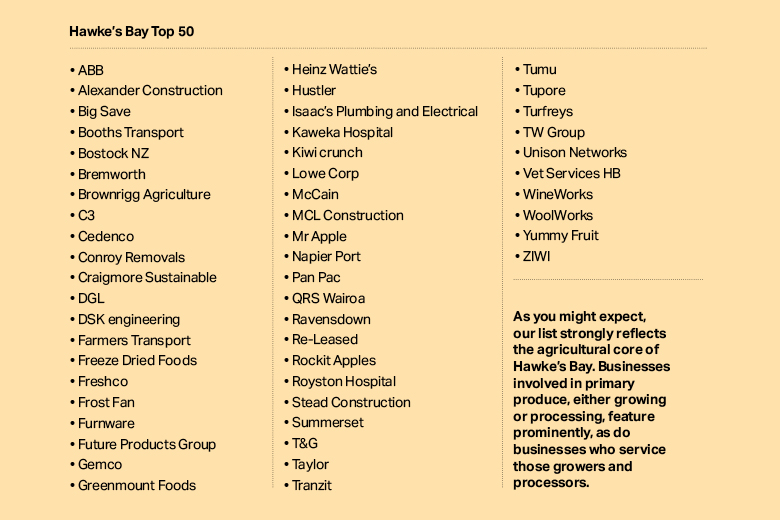
The accompanying chart lists our Top 50 by permanent workforce, in alphabetical order. As you might expect, it strongly reflects the agricultural core of Hawke’s Bay. Businesses involved in primary produce, either growing or processing, feature prominently, as do businesses who service those growers and processors. Our primary and adjacent sectors are one big machine, requiring a huge support network to sustain it.
The exceptions are businesses that operate in other sectors such as construction, healthcare, and infrastructure.
The smallest ‘big’ company in our Top 50 has only 60 employees, and there’s a few ties for employee numbers, so the Top 50 is actually the Top 52.
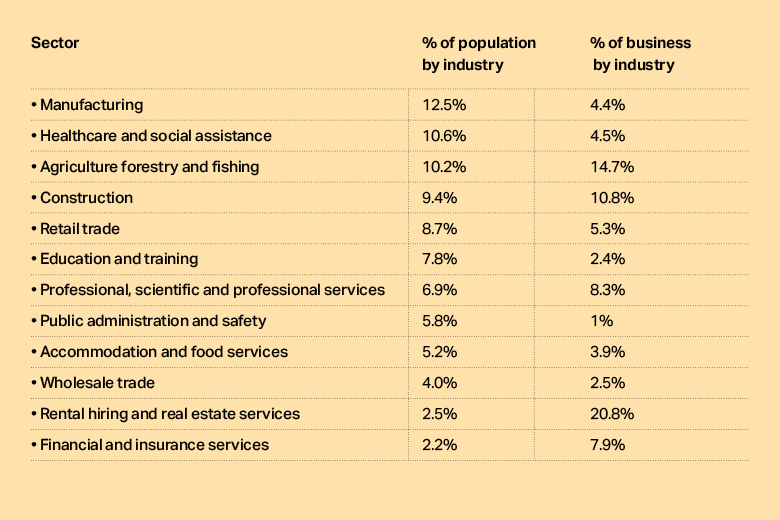
The table below details Hawke’s Bay’s percentage of employee population by industry, and the percentage of all businesses in that sector, demonstrating the impact of big players.
Who are our top 12?
Given our focus on permanent workforces, our Top 12 employers are as follows.
1. Tumu, permanent workforce 600
A family business with a 50 year track record that was founded in Dannevirke by Hugh O’Sullivan, to mill and sell timber from his farm. Now active in seven sectors: wood processing and manufacturing, property and development, finance, retirement living, transport and logistics, import and distribution, and private capital.
2. Heinz Wattie’s, permanent workforce 450
Food processer with nearly a century’s connection to the region. Now owned by multi-national HJ Heinz Group, one of the largest food and beverage companies in the world. Wattie’s produces and market a wide range of food products, including frozen and canned fruits and vegetables, sauces, baby food, and pet food, for New Zealand and export markets. Crops grown locally for Wattie’s include peaches, pears, plums, boysenberries, beetroot, corn, tomatoes, sweetcorn, pumpkins and onions. With seasonal workforce, 950.
3. Pan Pac, permanent workforce 450
Timber grower, processor and exporter. Operating for 50 years, and owned by Japan’s Oji Group, a pulp and paper industry leader. Produces mainly appearance grade timber and wood pulp products. Also has operations in Otago. Just over 1% of Hawke’s Bay’s work force is employed directly or indirectly by the company. Pan Pac’s contractors number 400.
4. Unison Networks, permanent local workforce 407
Electricity network business operating in Hawke’s Bay, Taupō, and Rotorua. Also owns complementary businesses in contracting, transformers, and switchgear, to ensure Unison is strongly positioned to leverage the opportunities and tackle the challenges associated with electrification. Unison’s vision is to lead a sustainable energy future that supports the changing energy needs of consumers.
5. Mr Apple, permanent workforce 400
New Zealand’s largest grower, packer and exporter of Apples. Part of Scales Corporation. Grows 12 varieties of apples on more than 50 orchard locations on 1,200 hectares in the region, exporting more than five million cartons of apples. Mr Apple’s seasonal workforce is estimated to be around 2000 workers.
6. Yummy Fruit Co, permanent workforce 340
Operated by the Paynter family, fifth generation orchardists specialising in apples and stone fruit, grown on 700 hectares in Hawke’s Bay. Was the first grower to individually label fruit in New Zealand.
7. TW Group, permanent workforce 338
Owned by Cam Ward and Simon Tremain. A vertically integrated property development, civil construction and trade business with 14 businesses under the TW umbrella. Offers clients “the full suite of development and construction services, from the planning phase through to the final lick of paint.”
8. Napier Port, permanent workforce 322
North Island’s second largest port by tonnage. Fifty five per cent owned by Hawke’s Bay Regional Council, with the remaining 45% listed on the NZX in 2019. Predominantly export focussed, with wood, pulp and paper, apples and pears, meat and other chilled produce making up the bulk of container exports. Log exports are the lion’s share of bulk cargo. The port’s operations indirectly support many thousands of jobs and businesses across the region.
9. T&G Global, permanent workforce 319
Grows apples in Hawke’s Bay, but also a grower of apples, tomatoes, citrus, and blueberries in other regions. Also partners with third party growers. Exports to more than 60 countries. T&G’s 12,500m2 Whakatū packhouse is one of the largest in the southern hemisphere, with the capacity to pack 125 million kgs of apples annually. Peak seasonal workforce for harvest 2025 was 670. Majority owned by BayWa Global Produce, a German conglomerate.
10. Bostock, permanent workforce 200
New Zealand’s largest grower of organic apples, also supplying onions, pumpkins, and organic apple cider vinegar to the domestic market. Exports to over 20 different countries throughout Europe, the Middle East, Asia and North America. Seasonal workforce estimated to be around 800.
11. Rockit Apples, permanent workforce 200
The snack sized apple developed for global consumers. Exported to 30 countries. Grown by the company or by licensed growers across 850 hectares in Hawke’s Bay and Gisborne. In 2021, Rockit opened a new 21,000 m2 United Nations-certified cool store and packhouse facility in Hawke’s Bay. Seasonal workforce exceeds 600 at peak times.
12. ZIWI, permanent workforce 165
Manufacturer of super premium petfood that’s exported to more than 30 countries. Invested around $120 million to establish ZIWI in Awatoto, including 12,500m2 $85 million super kitchen, after many years in Bay of Plenty. Pioneered air dried technology 20 years ago and continues to innovate producing a range of wet (canned), air dried, and freeze dried foods for cats and dogs.
Seasonal work complicates
There are some businesses whose seasonal workforces dwarf their permanent staff numbers, with meat processing being the prime example. Affco Wairoa has a total workforce of 650, but only 35 are permanent. Bay Buzz suspects that similar ratios apply at the region’s other meat processors (who have not disclosed permanent roles): Ovation – 400 workforce, and Silver Fern Farms – 900, which would mean 23 and 52 permanent roles respectively.
Our future job growth
A 2024 report from Infometrics, completed for the Hawke’s Bay Regional Economic Development Agency (REDA) predicted 6,000 new jobs between 2024 and 2029. This compares to 9,400 new jobs in the previous five years. Unsurprisingly, two thirds of new jobs in 24-29 will be in Hastings District, our economic engine. Healthcare, social assistance, horticulture and fruit growing are expected to create the most jobs.
Infometrics predicts 1,300 new jobs in health and social assistance, 1,100 in horticulture and fruit growing, 550 in professional scientific and technical services, 450 in other services, and 425 in administration.
Construction, and sheep and beef cattle farming industries are expected to shed jobs.
Across the rest of the region Napier is predicted to have 1500 new jobs, and Wairoa and Central Hawke’s Bay, hardly any.
Job creation reflects current and future market conditions, i.e. demand for goods and services, and the optimism of employers to hire.
For businesses to hire, in addition to optimism, they have to have a suitable labour pool. Quite a number of our Top 50 have workforces lower than that published on their website. One business, preferring anonymity, said this about their workforce: “We are looking for a lot more staff but they are simply, surprisingly, still not out there due to a few factors. Likely a lot of people moving to Australia when things went quiet in recent years in NZ for the construction sector. We particularly need more skilled commercial roofing staff.”
Other research published late last year by the REDA highlighted the lack of skills and talent impacting a “broad range of economic development participants”. A handbrake to our employers. Academically our students are not achieving at the same rate as New Zealand as a whole, and Hawke’s Bay Māori are further behind. More of us have no qualifications, compared to the rest of the country. Skills focused initiatives are not maintained or scaled up. And not surprisingly: the experiment to centralise the tertiary institutes like EIT has weakened local connections between tertiary provision and industry.
What are our chances of developing our own home grown pipeline of work ready, suitably skilled workers? Based on past history, pretty low.
And then there are the global factors like pandemics, bird flu, and the recent Trump instigated tariff war that impact demand for Hawke’s Bay produce, and the jobs it supports.
If our Hawke’s Bay private sector workforce is to grow, the make-up of our Top 50 tells us it will come mostly from our horticulture sector. Only this sector has enough scale to significantly grow our private sector workforce.
The rest, and no disrespect to the thousands of hard working business owners out there, is chicken feed in comparison. A precarious position for the region to be in.

great lists Tom groovy mate…..can you follow up on wages and salaries by jobs and how we fair there and have done over time?
Probably the largest “employer” in Hawke’s Bay (in fact, in New Zealand) are the volunteer groups – and they don’t get paid at all – but they do huge amounts of work countrywide – they never seem to appear in the statistics though. I would imagine that there’s at least 2000 in HB alone – what’s the value of their work to the region?
Very disappointing our regional economic development agencies (council & otherwise) don’t know who our biggest employers are. If they don’t know how and by whom our economy is powered, how can they make good decisions to support growth?
We asked businesses to get in touch if we overlooked any biggies. Here’s one … we knew of the pies but not of the size!
The Goodtime Pie Co. North Ltd, in 35 Turner Place Onekawa makes 80,000 pies/rolls per day and we employ 135 people at our Onekawa location. We have another bakery in Chch too plus a team of sales reps around the country. We also import and export.