

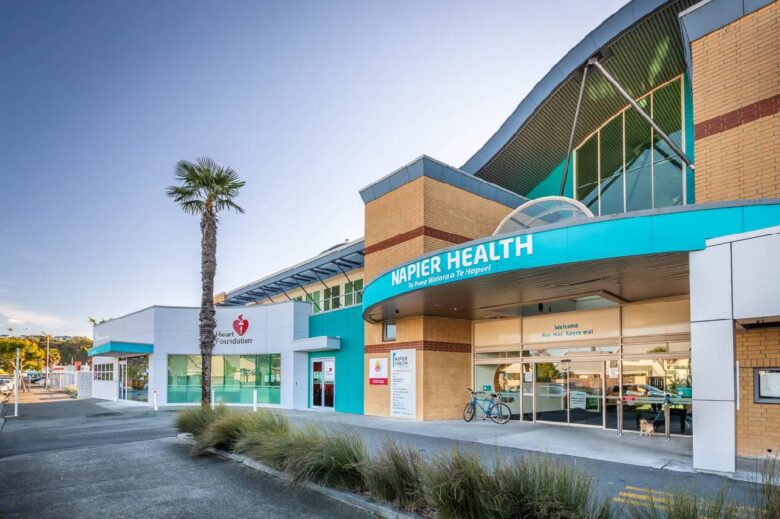
New Zealanders consistently treat healthcare as one of their top 2-3 concerns. Here in Hawke’s Bay, that gets reflected typically in concerns about level of medical services provided in Napier and Wairoa, access to GPs and specialists, and the deteriorated state of HB Hospital (see our latest post).
Unfortunately, perhaps the toughest government budget numbers to make sense of are those surrounding NZ’s healthcare spending.
‘Record levels’ or ‘failing to match inflation’.
Specialist and hospital care versus primary care.
Buildings and technology versus health care personnel.
So here is a remarkably straightforward assessment of the Government’s latest budget commitments to healthcare, as published by the Public Health Communication Centre Aotearoa, and reprinted with permission.
It’s authored by Paula Lorgelly, Professor of Health Economics at the University of Auckland and expresses a point of view (the ‘blame’ is shared across governments), but the numbers are extensively footnoted (those can be tracked in the PDF you can access below).
Insufficient and poorly targeted Budget means health system will continue to fall short
Billed as a responsible Budget, the government has thought it prudent to target its spending of our tax dollars on health, education and infrastructure. Health, including health infrastructure commitments, has been labelled the biggest winner among the Vote appropriations, with 70% of all new government funding allocated to health. The total forecast health budget for next year is $34.2 billion, which is a 10% increase from 2025.
Over four years, Vote Health will receive $5.8 billion in new funding.
But is it enough? And is it targeted at the right areas?
Stepping back from the dollar figures, let’s consider the state of our healthcare system. It is estimated that 6% of the population are not currently enrolled with a primary care provider.1 One fifth of those enrolled are not able to get GP appointments, often because they cannot afford it.2 This has resulted in unprecedented demands on our emergency departments.3 If you are lucky enough to get a specialist referral (recent estimates suggest 20% are declined)4, then there is a long wait for that specialist appointment, and long waiting times for elective surgery (with the system tracking below targets5). Medicines access is restricted; there are more than 100 pharmaceuticals on Pharmac’s Options For Investment list.6 If you are Māori, Pasifika or disabled, then accessing care is even more challenging, and your health outcomes are typically worse for it.7
This care, when delivered, is done so at increasing cost. Health insurers suggest medical inflation is well above general inflation,8 which aligns with global trends.9 This is while our ageing population is served by ageing hospitals, in need of upgrades and expansions.10
Finally, at the heart of this is a stretched and overworked health workforce, many of whom are attracted to careers and opportunities across the ditch.11
The state of our healthcare system demonstrates that investment and commitments are needed across the board to improve the system and deliver equitable health outcomes.
Minister of Health Simeon Brown called the Budget a “record investment” in health, but thiswould be true if the government merely kept up with inflation. A recent Kaitiaki Hauora report estimates that an additional $1.405 billion per annum is needed to “keep the lights on”.12 The summary of initiatives shows that $5.5 billion of the $5.8 billion funding is for frontline services, equivalent to $1.375 per annum; effectively $30 million short of the ‘lights on’ estimate.
The healthcare system described above is a result of years of underfunding, not just this Budget, but those that date back to the 2010s.13 To catch up, Kaitiaki Hauora estimates that a commitment of $6.834 billion for operational funding and $1.061 billion in capital investment is needed per annum. So, it certainly looks like we have not received the amount the healthcare system needs.
The Budget appropriations are in three areas:
- Hospital and Specialist services are to receive $15.995 billion (1.2% less than previous years);
- Primary, Community, Public and Population Health Services is to get $10.348 billion (6.3% more); and
- Hauora Māori will receive $0.811 billion (1.4% less).
The increase in Primary, Community, Public and Population Health Services is largely due to new commitments to ambulance services ($35 million) and extended bowel cancer screening ($33.1 million). Notably, there is no dedicated new funding for primary care, despite evidence that the greatest return on investment is achieved in primary care compared to other healthcare services. International evidence shows every dollar spent in primary care can save up to $13 in health expenditure.14 Comparatively, Aotearoa New Zealand spends 6% of its national health budget on primary care,15 while other OECD countries spend 14%.16 A sustainable primary care system does not appear possible under this Budget.17
At the hospital level there has been a decrease, despite new initiatives for postnatal care ($34 million) and paediatric palliative care ($15.5 million). Health New Zealand looks to be tasked with doing more with less. The $1.375 billion per annum noted above is for Health New Zealand to meet demographic demand, volume and price pressures. This initiative began in Budget 2024, when $1.430 billion was allocated each year.
It is also worth noting that Pharmac’s $54 million budget uplift over four years is unlikely to improve access to medicines. The $13.5 million per annum is less than 1% of their $1.76 billion 2025/26 budget. This is the smallest increase they have received since before the pandemic. It raises doubts that funding the weight loss drug Wegovy will come swiftly,18 while the more than 100 other medicines on the list will likely languish. It also brings into question the ability of Pharmac to deliver on Associate Minister of Health David Seymour’s reset programme.19
Beyond health services, infrastructure and cyber security appear to be the bigger Budget winners. There is a significant commitment ($668 million) of capital expenditure, improving hospital infrastructure, with new wards and buildings upgrades, and providing more beds.
However, this is unlikely to directly deliver health improvement, unless the new wards and beds are staffed. A recent report on rural and community hospitals found below average bed utilisation due of workforce shortages.20 Roemer’s Law is that a built bed will be a filled bed,21 but without a nurse, a hospital bed is just a bed. Aside from the previously committed new medical school, there are no specific initiatives to address workforce recruitment and retention.
The $153 million to improve IT cyber security will be welcome in light of the recent independent review into the health data hacks.22 It is important to acknowledge that the data and digital infrastructure does not just need to be secure, it needs to be usable, and systems and databases need to interact with each other. Currently, IT is fragmented, and we are falling behind on delivering data-driven care.23 A rate-limiting step here is that many IT roles were lost in previous Health New Zealand restructures.24 So, health data may be secure, but health improvements resulting from this are not expected without further budget commitments.
Overall, Budget 2026 is a mixed bag for health. The investment will deliver health improvements for some populations, including specific geographic regions, but the lack of targeted funding for primary care will likely undermine broader health system performance.
You can download the article with all references here.

Puts a lot of things into perspective – I really liked the statement that a hospital bed without staff is just a bed – maybe a touch more thought should be given to training a lot more nurses etc and paying them a decent salary that compares with those overseas. But then again this Government is not one that allows the peasantry a living wage that compares to similar countries – no wonder our best and brightest head overseas