

[As published in July/August 2026 BayBuzz magazine]
The HB Chamber of Commerce and Unison recently sponsored a valuable ‘Energy Summit’ that combined ‘big picture’ energy scenario presentations from the likes of Transpower and the Energy Efficiency & Conservation Authority (EECA) with several local ‘hands-on’ energy use examples from significant energy consumers like Pan Pac, Apollo and Napier Pine.
A presentation from Toitū, a Crown science entity advising on emissions reduction and sustainability certification, concluded with the admonition: “In God we trust; all others must bring data.”
And indeed, if there was one message permeating all the presentations, it was ‘measure, measure, measure!’
It’s a message that sounds self-evident, but it seems that many businesses and users continue to fly blind in terms of where and how precisely they use energy, where to assign the costs, and therefore how best to achieve savings. Those could be bottom-line operational and capital cost reductions or ‘public good’ savings (like less climate emissions and health-threatening air pollution).
The pressure is building. In the business world, measurement that started as simply another way to improve profitability, then became further driven by an externally-imposed ‘mandate’ to reduce carbon emissions, has now been elevated to the status of protecting energy security – ensuring the very survivability of energy-intensive businesses in the face of escalating electricity and gas prices (and threatened access in the case of gas).
Sophisticated energy audits are now de rigueur for any significant power-using business that isn’t functionally brain dead.
In Hawke’s Bay
Here in Hawke’s Bay, the closures at both Wattie’s and McCain are in no small part a function of the high energy costs of food processing, and especially freezing.
At the same time, a number of Hawke’s Bay businesses ‘opened their raincoats’ at the summit and talked about the energy solutions they were implementing … always beginning with thorough auditing of their energy usage, opportunities for demand reduction and then their cost-effective options for alternative power supply.
Amongst this group, the big kahuna is Pan Pac.
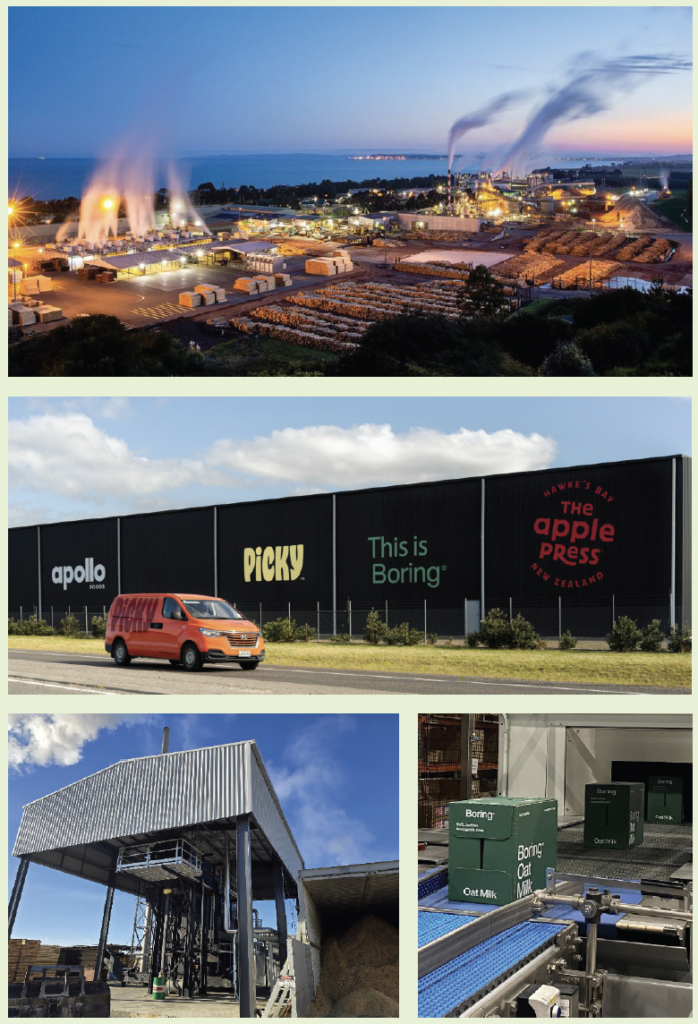
With two biomass boilers at its Whirinaki plant, Pan Pac is one of New Zealand’s largest industrial biomass users. The site consumes up to 250,000 tonnes per year of biomass wood fuel. The power is converted to process heat to dry pulp and lumber.
Their experience illustrates one situation where biomass is proving cost effective – where the need for process heat is steady, not intermittent. Pan Pac says biomass works best for continuous heat users like food processing, industrial drying, industrial process heat, and heating for buildings, hospitals, schools – anywhere with a reasonably steady base load.
Of course, Pan Pac has the sourcing and logistical capacity to meet its wood fuel supply needs directly, and can project that ‘real world’ supply out 30-plus years, noting that ‘theoretical’ supply projections sometimes proffered by biomass advocates do not necessarily translate into practical availability.
That said, Pan Pac believes the region’s fibre supply is greater than required for HB heat users, saying: “Biomass Wood Chip (FSC certified) and other biomass wood fuel grades are already available at scale in Hawkes Bay.” Currently, Pan Pac’s existing ‘spare’ chip processing capacity is 3600 tonnes per week, equating to around 25,000 GJ/week of usable energy.
According to EECA, around New Zealand there are some 30-plus large industrial users, 80-plus schools and 20-plus commercial installations using wood energy,
One of those is Hawke’s Bay company Napier Pine.
This company also faces the challenge of drying lumber, and they have made the transition from using natural gas to biomass.
Hawke’s Bay uses less than 2% of the nation’s current (and quickly diminishing) natural gas supply. Nevertheless, those local businesses who do rely on this source need to do some serious near-term planning.
Napier Pine was using a gas boiler to heat kilns drying approximately 1,200m3 of lumber monthly. Their monthly gas bill (2022) was $33-$47,000 per month. The energy cost was $30-$43m3 lumber dried.
After the switch to a biomass boiler, the drying energy cost went down to $10m3. Moreover, the projected 6.7 years pay-back time for the investment will be instead only 4.1 years. And with a consented requirement to emit no more than PM10 2.0kg per hour, their tested PM10 emissions range from 0.389 to 0.470 kg/hour.
Sounds like a win-win-win.
Like Wattie’s and McCain, another Hawke’s Bay processor also faces the challenge of escalating energy costs and dependence on gas.
Apollo, in the juice and milk beverage business (The Apple Press, Picky, Boring), is enjoying strong growth, in the last year moving to 24/7 production.
Energy costs account for 16% of Apollo’s total overheads. And as they put it: “Energy usage directly correlates to production output.” Three-fourths of their energy use is gas, while electricity at 25% nevertheless accounts for over half the energy cost.
On the one hand, Apollo faces a dwindling gas supply, but currently electricity, at two-times the per-unit cost of gas, is too costly to make electric boilers financially viable. So, their immediate step is to achieve about 7,200 GJ in energy savings across two years. Longer-term, they plan to install hot water recovery to cut their on-demand steam load and eventually replace their gas boiler with biomass, requiring as they put it: “Significant capex, contingent on co-funding and partnership support”.
These are the kind of trade-offs and options any industrial user of gas would be investigating these days, whether or not a LNG import facility proves to be the best short-term supply band-aid.
Perhaps more promising, the Government has announced its Gas Transition Loan Guarantee Scheme to support fuel-switching and energy projects that reduce gas use by at least 15%. Businesses that use at least 1,000 GJ of reticulated gas per year will be eligible for bank loans of up to $50 million with the Crown guaranteeing 80% of each loan. EECA will help businesses get investment ready.
National energy future
The latest NZ Infrastructure Commission report on energy notes: “Questions remain about how gas exits the system: at what pace, with what support for affected users and infrastructure, and how the electricity system’s firming needs will be met as gas-fired generation declines. The issue is not whether gas production continues to fall but whether that decline is managed in a way that limits disruption, or reactive in a way that compounds it.”
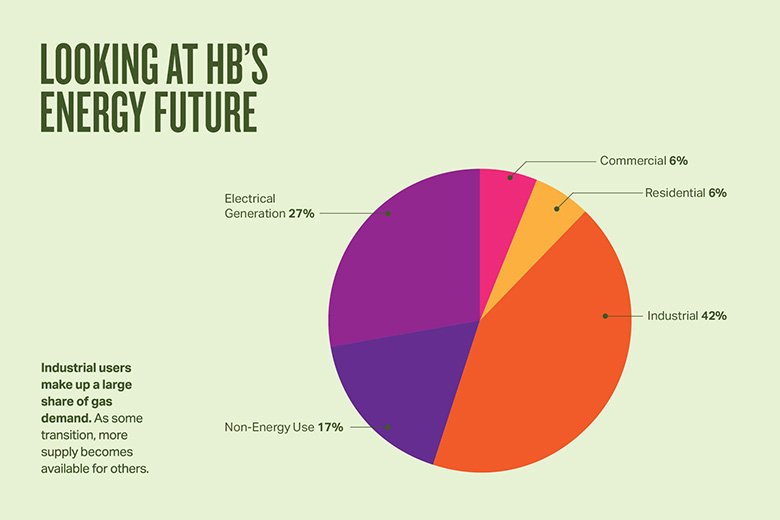
PowerCo, which delivers gas to 23 industrial users, 377 commercial users and 5,028 residences in Hawke’s Bay is bullish on renewable options like biomethane, produced from agricultural and food waste and landfill. The company is targeting 20% renewable gas by 2035 with an unspecified long-term goal of 100% renewable.
Overall, according to the Infrastructure Commission, there are $22.8 billion worth of energy projects in the national infrastructure pipeline. An Electricity Authority dashboard reports 289 renewable generation projects in the pipeline with a combined capacity of 44.29GW, over four times current national generation capacity. The Commission estimates that between $2 to $5 billion per year over the next 30 years will be required to meet renewal and business-as-usual growth requirements in electricity generation, transmission and distribution. An additional $835 million per year on average will be needed to meet decarbonisation-related electricity demand.
Renewable electricity generation in NZ exceeded 95% in the last quarter of 2025. By now, renewable electricity sources have become much cheaper to build while continuing to have low to zero short-run operating costs, as they don’t require fuel. Conversely, thermal electricity generation has become more expensive to run, meaning they now need higher prices to be commercially viable. Seven have shut down in NZ since 2007.
With its abundant renewable energy options, NZ should be well-positioned to resolve the ‘energy trilemma’ – delivering low priced energy, reliably supplied, with low emissions.
The HB energy initiatives described above illustrate that attentive businesses will identify and respond to win-win energy options when those are locally available. Households will as well. But what we locals cannot control are the policy settings that could facilitate and accelerate transition to these options.
For that, we need a Government that is not committed to extending our fossil fuel dependency.
Presentations from the Energy Summit can be viewed here.

