


In news of relevance to HB’s agribiz economy, this week the Government announced that NZ exports rose to $29.2 billion for the December quarter, up $2.2 billion on the same period last year.
Trade Minister Todd McClay said: “New Zealand exporters are winning in highly competitive global markets. Our farmers and growers are recognised internationally for their quality, reliability, and innovation. And these results are a testament to that.”
Of our top exports, the highest performers were dairy (up 10%), tourism (up 9.4%) and meat (up 21.4%) for the December quarter, compared to the same period last year, with the latter two especially pertinent to Hawke’s Bay.
Note that these figures are always about dollar value, not profitability or employment or productivity. Revenue growth is great, but …
There’s much worry these days in NZ about the poor productivity of our economy.
In the primary sector, the driver of HB’s regional economy, ‘productivity’ growth comes in two forms – from fortuitous externalities and from output growth genuinely based upon technology innovation and capital investment. Hopefully both of these might be accompanied by increased profitability for farmers and growers, but that is not necessarily the case.
By ‘fortuitous externalities’ I mean factors completely outside the control or management by our farmers and growers – the weather being the prime example! Our apple growers are ecstatic about their expected harvest this year, well up in quantity and quality, but chiefly because of exceptionally favourable weather. Their industry defines ‘productivity’ as yield per hectare planted. Higher yields are cool, but that alone a bit deceptive.
More apples per hectare simply because of good weather is a ‘here today, possibly gone tomorrow’ factor. Good weather is not productivity.
On the other hand, more apples per hectare because R&D has produced more heat resilient trees, or varieties better suited to overseas tastes, or more disease resistant fruit, or trees more efficiently harvested because of shape (or even robotics) – those would better qualify as improving ‘productivity’ … and all backed by capital investment to develop the innovations and indeed plant the appropriate trees.
Some of these might not only increase yield, but, by reducing costs, also profitability, which is what actually benefits and motivates the individual growers and their communities, not gross national statistics.
Ask a money losing grape grower in Hawke’s Bay, which is most of them, whether growing more grapes per hectare is more profitable.
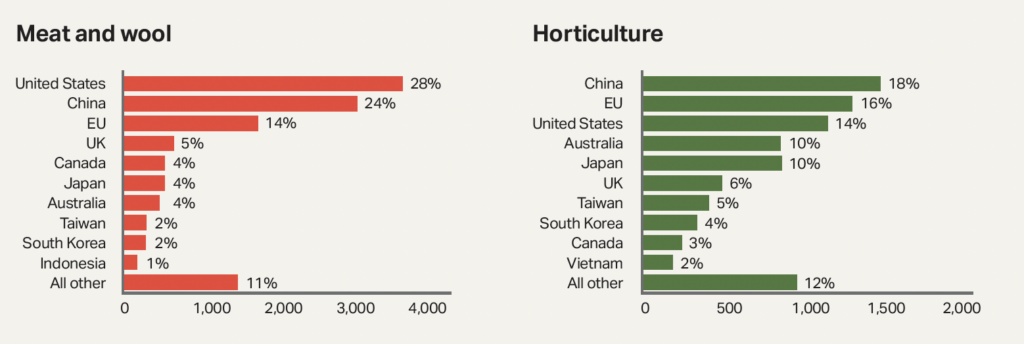
And then there’s beef and lamb – 28% of NZ’s goes to the US, our #1 meat market. The gain of 21.4% in export value is a function of especially high prices overseas, driven by low US domestic supply and Brazilian beef impacted by a 76.4% Trump tariff. Neither of these factors has anything to do with the intrinsic productivity of the NZ meat industry.
And while apple production volumes are at least looking up, NZ’s numbers of cattle and sheep are going down.
It would appear that if pastoral farmers are to become more profitable (and thereby sustainable), that will need to come via reducing costs (e.g. energy, fertiliser) rather than increasing kilograms of meat per hectare.
Add to all of this, the weak NZ dollar, making our 2025 exports that much more attractive. Again, a situation no individual farmer or grower controls.
OK fine, let’s celebrate the higher value of our exports, but in the case of primary sector exports, let’s not fool ourselves into thinking this is being generated significantly by improved productivity.
Minister Todd noted that one in four Kiwi jobs are linked to trade. In Hawke’s Bay those export jobs are linked predominantly to our primary sector. So let’s treat innovation and productivity in our primary sector far more seriously. HB needs more champions for that.
Praying for good weather is not a sustainable growth strategy.
