

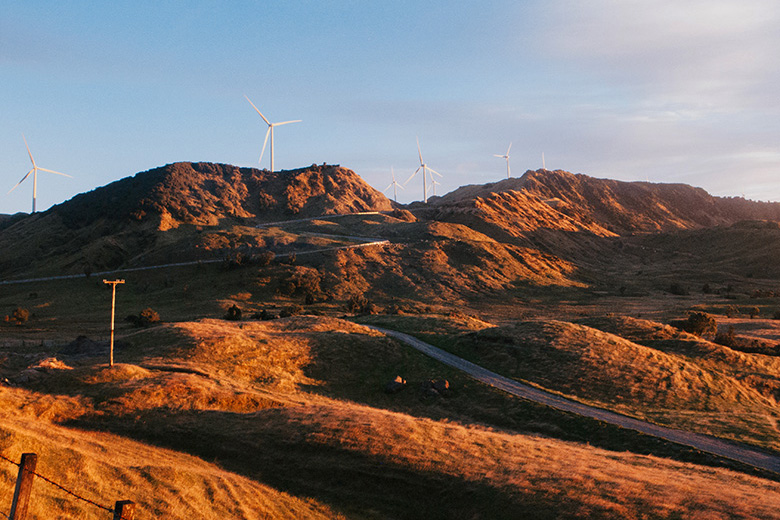
Is it a far-fetched ‘blue sky’ fantasy to imagine Hawke’s Bay as a region entirely fueled by renewable power?
Do we need a regional strategy to get there … or do we just go with the flow?
Already most of our electricity on any given day – delivered to our doorstep at Redclyffe power station by Transpower – is generated by renewable sources outside the region. This reflects the nation’s overall power generation profile, which is grounded in hydro, geothermal and increasingly solar and wind.
According to MBIE, that profile (at 2024) consists of hydro at 60.5%, geothermal at 17.8%, wind at 7.4% and solar at 0.9%. Nationally, NZ’s installed solar grid-connected capacity is about 573MW.
NZ’s biggest power players, like Genesis, Meridian and Contact, are all publicly committed to expanding their renewable generation.
Contact recently announced a $525 million capital raise to be entirely devoted to renewables generation – geothermal, solar and large-scale battery storage. “We’re investing in the infrastructure required to support a more renewable, resilient and affordable energy future for New Zealand,” said chief executive Mike Fuge.
Meridian seems to favour the Napier-Taupo Road. It owns the 176MW Harapaki Wind Farm north of Napier, which can generate up to 550GWh per normal wind year. And plans to build Te Rahui, a 200MW solar farm beside the road at the Hawke’s Bay-Bay of Plenty boundary.
For its part, Genesis also recently announced a $400 million capital raise, mentioning “accelerating investment into renewables” and battery storage. Genesis figures that for NZ to reach its net zero emissions target by 2050, 60% of the country’s energy needs to come from electricity, with 95% of that from renewables, noting also that the renewable portion needs to be available 100% of the time. Malcolm Johns, CEO of Genesis Energy, treats those goals as “the first principle of our operating context for the next 25 years: 60 – 95 – 100”. For its ‘dry year’ cover, Genesis aims to use 300,000 tonnes of biomass to replace its coal generation by 2028.
Local picture
As Mark Sweet reported in our recent Summer edition (see Electricity is power), Hawke’s Bay is not lacking in renewable projects and aspirations.
What is the electricity demand to be met? Unison reports that total electricity consumption in its Hawke’s Bay network in 2025 was 986 GWh. This doesn’t include consumption in Central Hawke’s Bay (Centralines) or Wairoa District (Firstlight Network). And HB’s electricity consumption is certain to grow. Unison plans to spend over $600 million over the next ten years to service that growth.
As noted above, Hawke’s Bay is an ‘importer’ of electricity … at least currently. New renewable generation capacity contributed by local wind and solar operators does not necessarily power HB homes and businesses rather this output generally feeds into the national grid, enriching its overall supply mix, some of which returns to us via Unison’s lines.
There are some exceptions.
Genesis Energy’s Waikaremoana hydro scheme generates electricity into Transpower’s regional grid – that supplies both Hawke’s Bay and Tairawhiti. And a solar project planned by Centralines and Lodestone Energy in Ongaonga will feed its approximately 52GWh annually directly into the Centralines distribution grid in Central Hawke’s Bay. The scheme will power the equivalent of 9,000 electricity connections. At peak generation, the farm will power the entire district while still exporting excess to the national grid.
Eat your heart out Taradale and Havelock North!
[Parenthetically, Lodestone is a major solar success story. Its vision is “a solar farm in every community” and the company currently generates 230GWh of renewable energy across four farms around NZ, enough to power 32,000 homes. It is working on its fifth farm now, with six more consented, aiming to generate more than 800GWh of renewables annually, which would effectively triple NZ’s solar generation from 2022 levels.]
Two other large scale CHB solar projects are on the drawing boards for CHB. Both could theoretically also feed the national grid, making CHB the electricity export capital of Hawke’s Bay.
Meantime, HB Airport, whose terminal is already powered by renewable energy, is planning a solar array capable of meeting all of the airport’s electricity needs, as well as capacity to sell power to the local grid.
At a smaller scale, Hawke’s Bay has an estimated 3,250 solar installations, with a generating capacity around 18.8MW (there are about 73,000 installations nationally).
Electric vehicles
Powering homes and businesses is one thing. Replacing petrol is another.
Hawke’s Bay is home to only slightly over 2,000 EVs and PHEVs out of some 150,000 light vehicles, and maybe as many as 10,000 petrol hybrids if HB’s profile matches the national picture.
The Coalition Government hasn’t been helpful in that regard, both terminating financial incentives for EV purchases and relaxing fuel/emission standards for light vehicles.
When the EV incentives ended, EV sales crashed.
Ultimately, the real driver of EV adoption will be market price, despite the manifest ‘public good’ benefits of electric vehicles.
That said, more and more EV options are coming to market, including lower cost vehicles and steadily lengthening battery lives. The trend to EVs, whatever its pace, is inexorable.
Smarter use
The challenge is not just more electricity, we could also use what we have more efficiently.
Here, the chief opportunity lies in shifting electricity use away from peak demand periods – like when we all come home from work on a cold winter night.
The Energy Efficiency and Conservation Authority (EECA) recently estimated NZ could save up to 1900MW this way. Using Transpower’s formula – estimating a $1.5b cost reduction for each gigawatt of peak demand reduction – this would yield almost $3b in avoided infrastructure investment.
The main opportunities lie in less residential demand on the grid. More home solar coupled with batteries would obviously move us down that path. But so would wider adoption of home energy management systems, smart thermostats and controllable appliances. Investment in industrial-strength storage batteries is another opportunity for businesses.
The economic benefit is not just reducing the nation’s infrastructure budget, but lowering household and business daily energy costs as well, which are driven by peak use pricing.
Beyond electricity
Apart from petrol and diesel used for transport, Hawke’s Bay’s other main energy source is natural gas, obviously not locally produced.
Unfortunately, comprehensive energy use statistics by region are not compiled by the government, which is a shocker given the lifeline importance of the sector.
BayBuzz has relied on AI to assemble a reasonable Hawke’s Bay profile, complied in part by extrapolating from national supply and consumption patterns.
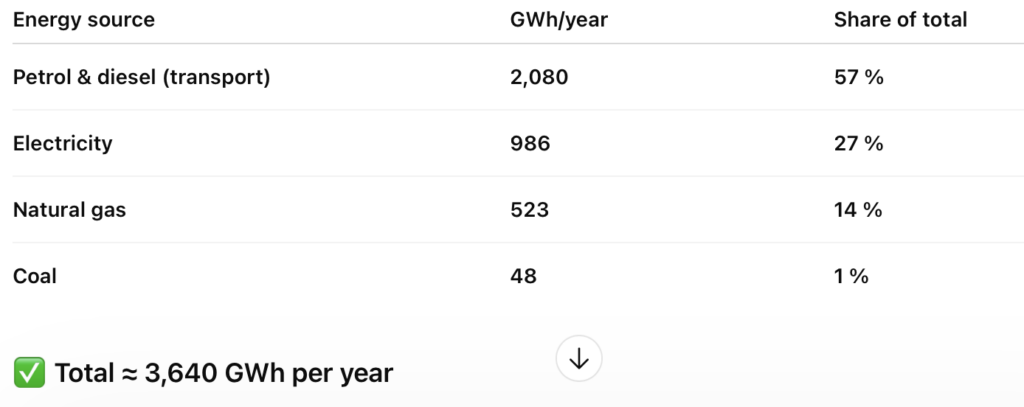
NZ as a country faces declining gas supplies, a trend that will continue according to all the outside energy experts who have examined the situation, despite the Coalition Government’s oil and gas exploration incentives. The latest Government proposal, for a floating gas terminal for storing imported gas to cover ‘dry year’ electricity shortfalls, when hydro supplies are insufficient, is seen as a transitional band-aid at best. And experts challenge even that case. But the alternatives are also challenged – it seems to be a ‘pick your poison’ situation for the near term.
For Hawke’s Bay, gas consumption is mainly for industrial process heat. Some companies have moved away from gas boilers independently – Napier Pine (to biomass), Bremworth, WoolWorks and Ovation (to electric). [And AFFCO from coal boiler to biomass.] Smart business planners can see the future, even if Government leaders cannot.
As BayBuzz reported in detail in Biomass … an energy solution for HB, our region’s large-scale alternative to industrial use of gas could be biomass. The EECA has studied our region, and concluded with a report indicating that each one of HB’s 44 main industrial gas users (accounting for 86% of HB’s piped gas) would benefit financially from switching to biomass as their fuel source.
I won’t repeat the analysis here, other than to identify the main obstacle to large-scale biomass conversion – no single player can make it happen.
Collaboration and coordination would be essential amongst both suppliers of the biomass (chiefly the region’s forest industry) and top industrial users. That would involve a central supply hub for the wood residues and a group(s) of users – say at Awatoto or Whakatū – aggregating their demand and feeding off the shared supply.
Is private sector planning and collaboration on that scale remotely feasible without a government enabler?
Regional energy strategy
Hawke’s Bay does not have a regional energy strategy; other regions do – for example, Waikato, Southland, West Coast and Taranaki.
Seems like a no-brainer – not in any ‘command and control’ sense, but at least identifying the region’s energy vulnerabilities (facilities, sites, supply lines), supply and resilience opportunities, demand reduction opportunities, achievable emissions savings; providing public/consumer education regarding efficient use and home generation, and promoting information sharing to accelerate business adoption of best technology.
And more ambitiously, maybe even setting a goal to be a net energy exporter as a region, at least with respect to electricity.
In such areas, the strategy would identify the ‘owners’ of the tools, capacity and authority to make changes. That in turn would allow regional political leaders to convene the relevant players, help coordinate, facilitate (in the consenting sense) and perhaps press for action if needed.
One might have assumed the HB Regional Economic Development Agency to play such a role from the public sector perspective (and it did participate in looking into the biomass opportunity). But that Agency will terminate shortly, with an undefined (as I write) successor to pick up such a responsibility.
Of course energy use is a key driver of GHG emissions (although animals are a bigger driver in HB). So one might think the Climate Action Joint Committee could fashion at least an ‘energy strategy-lite’ as part of its workplan. But that Committee is also twisting in the wind as our five councils reconsider their support for this undertaking.
The Regional Council by definition ‘thinks regionally’ but it hasn’t regarded energy to be as compelling a regional issue as water. And in any event, it too is twisting in the wind, anticipating the Government’s ax as it moves to ‘simplify local government’.
And finally, there’s Unison, with the industry knowledge and intelligence to be a thought leader in this space, but appearing hesitant to speak out beyond its formally prescribed role as lines distributor of electricity. Unison says Hawke’s Bay can’t go it alone.
“Energy operates as a connected national system, which is why a clear national energy strategy is important for the long‑term prosperity of our nation. That long‑term direction provides certainty and confidence for communities, industry and investment,” says Jason Larkin, Unison’s Group General Manager Customer, Commercial & Regulatory.
“Take the country’s dry year challenge, we need to take the politics out of it, there is no single ‘silver bullet’ and all the options on the table have trade-offs. We need multilateral support for a process to objectively work through the options and trade-offs, select the solution that is in the best long-term interest of electricity consumers, and implement it quickly so we can continue to have access to affordable and reliable electricity which is essential to our wellbeing and economy. All of the existing and future infrastructure we need would benefit from a non-partisan approach to planning and delivery.”
Where does that leave us, will we ever see a HB energy strategy? Doubtful … it’s certainly on no one’s priority list today. What we are more likely to see is smart businesses and homeowners independently looking for ways to drive down their energy needs and costs … and hopefully doing so at an accelerating pace.
Maybe all that random individual effort can at least be documented as we lessen our region’s energy footprint … a valuable regional goal.
BayBuzz stands ready to celebrate such achievements. Let us know if you have an energy savings story to tell.


Admittedly an opening cost would be high but surely long term the costs would be worth it – if we followed Australia (sorry I didn’t mean to use bad language) and subsidized solar panels on every rooftop in HB (or at least 80% of them) – surely that would reduce our reliance on the national grid even if just for water heating and powering up EV’s (if we are ever able to afford one)