

[As published in July/August 2026 BayBuzz magazine]
Napier is making up for lost years. The scale and speed of work required and some of the solutions being implemented may still leave something to be desired.
Napier is currently undergoing massive investment into its drinking, wastewater and stormwater infrastructure with a schedule of capital works that is impressive, and ramping up.
Mayor Richard McGrath campaigned last year on a back-to-basics platform prioritising water and roads, but previous Mayor Kirsten Wise was also known for her focus on water and much of the works programme was already planned and budgeted for in the Long Term Plan.
In some respects McGrath has already lost ground with his council voting in August to proceed with transferring the city’s water assets to a regional water entity owned collectively by Napier City Council, Hastings District Council and Central Hawke’s Bay Council.
Public consultation before the council vote also favoured that option over keeping the assets in-house, with 79% of the 666 submissions (considered a very good turnout) giving the regional water entity the thumbs up.
The new entity, which becomes operational on 1 July 2027 will, it is argued, offer cost efficiency, shared expertise, enhanced resilience and improved investment capability.
McGrath has been vocally opposed to the regional water entity, calling it ‘amalgamation by stealth’.
“If any city could have continued to run its own water under the new rules it would have been us. We had the finance and the desire in the community to do it standalone or in-house. I think we would have been better off.
“Any Napier project would be a number one priority. I have concerns that in the future if there are bigger priorities in other parts of the region, where our priorities might sit. I’m hoping they will be able to do them all at once, but that is yet to be determined.”
However, he is forward focussed and “comfortable” with the progress being made.
“We put a plan forward for the next however many years of what the priorities will be. The new water entity will take that on board initially and then it will work to prioritise around the region what gets done. The government says we had to do this because we weren’t prioritising, which is a bit of a shame really. I think we’ve jumped a little too far too fast by going into the water entity.”
Current projects underway in Napier
Across all three waters there is a lot going on.
The city is increasing drinking water capacity and upgrading pipe networks and bore infrastructure, replacing the ageing wastewater outfall pipe, creating an alternative overflow path for stormwater in Maraenui and Te Awa, and building new pump stations – all to be completed in the next three years.
Napier’s serviced population is set to grow from 67,490 now to 75,365 in the 2032/33 financial year and the infrastructure must be capable of coping with that extra pressure on the system.
“There are definitely some stresses because we can’t head outwards, we tend to have to head upwards, or in-fill, and that creates stormwater pressure because every time you put some concrete down that’s another bit not being absorbed into the ground,” says McGrath.
Executive Director of Water Services at NCC, Russell Bond says the approximate capital spend for 2026 is $30 million, jumping to $60m next year, and $100m in 2028. The combined cost of water infrastructure upgrades and compliance is projected at $701 million through to 2034.
Wastewater
Of all the various projects underway, Bond says wastewater is the most urgent due to the public health risk to the community in the event of a Moa Point-type failure, which would result in sewage spilling into Hawke Bay.
The risk is not theoretical. Much of the wastewater network has less than 20 years of useful life left, according to the Hawke’s Bay Water Services Plan, with a significant portion of assets assessed as being in “poor or very poor condition”.
Accordingly, the concrete outfall pipe that carries treated sewage from Awatoto 1.5 kilometres out into the bay, is being replaced.
Built in 1973, not only is the existing pipe degrading, it has also been expensive to maintain, with three repairs in recent decades. In 2020, the city spent more than $1.2m on repairs, and another $65,000 just last year for a diffuser repair.
Its operating limit is now being deliberately kept 200 litres a second below the consent volume of 14,000 L/S to reduce stress on joints. But this in turn puts extra pressure on the wider network and requires overflow volumes to be kept in storage cells that were completed only last year.
The replacement pipe is currently being designed with construction planned to commence mid-2027, which will take about a year. It will run from the Awatoto treatment plant to an offshore diffuser.
However, previous Bay Buzz reporting laid out how the use of trickling filters and offshore discharge is increasingly outdated by both technical and cultural standards, with advanced systems elsewhere now treating wastewater as a recoverable resource, aiming for zero discharge and energy neutrality.
It’s likely that the current system will be non-compliant with future expectations under evolving regulatory standards. Something the new joint entity will need to deal with.
Stormwater
The second most urgent is stormwater upgrades, Bond says.
“Stormwater is a close second, because it affects habitable floors – living areas. There is a lot of work we have been doing in that area. We’re looking at improving flood protections there so Kāinga Ora can build more houses. We have committed to that work in partnership with the National Infrastructure Fund. We are looking at construction starting soon on those outfalls and pump stations.”
The planned housing developments in Maraenui and Te Awa make the requirement for an alternative overflow path to the existing Plantation Drain, which takes stormwater flows north to the estuary, rather pressing. The existing system did not stand up to the 2020 floods. As a result, the council is redirecting strong flows south to Te Awa’s Serpentine Pond, from where it will be pumped out into the bay.
New pump stations powered by diesel generators are planned on Te Awa Estate Reserve, and a new outfall pipe is being built as well. The pond will also be enhanced to improve water quality and reduce odours. These works are in the design phase with construction due to begin next year, and will contribute to reduced flood risk for both Maraenui and Te Awa.
Another important stormwater project currently underway will widen the culverts at Taradale Road and Herrick Street. “It’s another big activity as well. We are trying to provide more capacity through that waterway. In the 2020 floods it was a real bottleneck,” says Bond.
Too little, too late?
However, when it comes to stormwater, Regional Councillor Neil Kirton says all this falls short, leaving the city vulnerable to another flood event like the one in 2020.
“My concern is that we really haven’t progressed significantly from that event and we still face what I think is the highest level of flooding, concentrated in Napier. We haven’t invested significantly to mitigate that. It needs much more than an alternative overflow pathway.
“There are two components of the network – the pipes network and the urban waterway network. And they are interconnected because the pipe network flows into them. The overall state of the network can only be described as poor, it’s likely to be functioning at a one-in-five-year flood level. It’s supposed to be a one in 50 or one in 100 service level,” he says.
Kirton applauds the “significant piece of work” on the Taradale Road and Herrick Street culverts, and acknowledges that there have been some upgrades on some of the pump stations.
Nevertheless, he describes the work as “cosmetic” given the expenditure needed to improve stormwater infrastructure, that he estimates should be in the ballpark of $150-$200 million. He reels off a hefty list of important stormwater capex projects that have yet to even begin.
“It’s too little and too slow to meet current demand and risk … I feel that NCC officials are pulling the wool over everyone’s eyes.”
McGrath responds, “We certainly need to do more and we do need to stay focused”, but counters that central government reforms – Three Waters and Local Water Done Well – have detracted from project delivery, along with the disruption of Cyclone Gabrielle, the impact from which could not be overestimated, he says.
“Those impacts were made worse because of failing stormwater assets including stop banks. That’s a key reason why we are taking over the regional council’s stormwater assets within Napier. We will maintain those to an urban standard rather than a rural one.”
The flow on effects of getting stormwater right will positively impact the city and region, and enable more housing, he says.
“When we say we must do the basics really well, this is exactly what we are talking about. Earlier models of managing water assets haven’t been satisfactory. I know that, our water teams know that and the government knows that, that’s a main driver for change.”
Ahuriri Regional Park – back to the drawing board
The planned recreational park at Lagoon Farm, part of another important stormwater project budgeted for in the Long-Term Plan, is facing considerable setbacks.
More than 70% of Napier’s stormwater currently discharges into the estuary, an ecologically and culturally important body of water. The estuary is facing numerous challenges, but stormwater discharge is among the biggest.
A June meeting of the Joint Committee (NCC, HBRC, Mana Ahuriri) that governs the development of the regional park resulted in the unanimous decision to pause the recreational development concept until “viable stormwater and environmental solutions are established”.
The separate stormwater project will continue to progress to improve flood mitigation and water quality in the estuary, but the planned wetlands on the park site, which were intended to store and filter, then slowly release water into the estuary, is on hold.
At the core of the issue is the bird strike problem (search ‘birdstrike’ on BayBuzz website for our previous reporting).
The proposed site lies directly within the zone of highest strike risk, with some of the bird species, like black swan, Canada goose and mallard posing an “extreme risk” of bird strike, according to a new report, which strongly recommended the Joint Committee reconsidered the location of the proposed park.
“Specifically, the site should be relocated outside the airport’s critical approach path, at a minimum, beyond the 3km bird strike buffer zone,” it states. Hawke’s Bay Airport has the highest bird strike rate in New Zealand as of 2025, and its management is firmly opposed to the wetland and park development on safety grounds.
But recent investigations have also identified another significant challenge with the park’s masterplan concept.
“A geotechnical assessment found the highly permeable soils at Lagoon Farm are not suitable for the scale of wetland development originally proposed without significant engineering interventions,” the press release states. The cost of addressing the geotech issues is estimated at $23m, which would take the total project cost to $56m.
However, new options to move the project forward, rather than relocate it, will be developed collaboratively by NCC engineers, the Mana Ahuriri Taiao team and specialist ‘nature based solutions’ advisors before being brought back to the Joint Committee for consideration. Joint Committee documents reveal that members feel that “failure is not an option”.
Mayor McGrath has previously stated that it wasn’t the right time to be spending on recreational developments, but he supports the stormwater retention aspect of the project.
“Just because it’s in the Long-Term Plan doesn’t mean it gets done. In this situation it really hasn’t stacked up. You’ve got to look for some alternatives.”
Drinking water
NCC is working on several projects to increase water storage capacity, along with upgrading the pipe network and installing new bore sites.
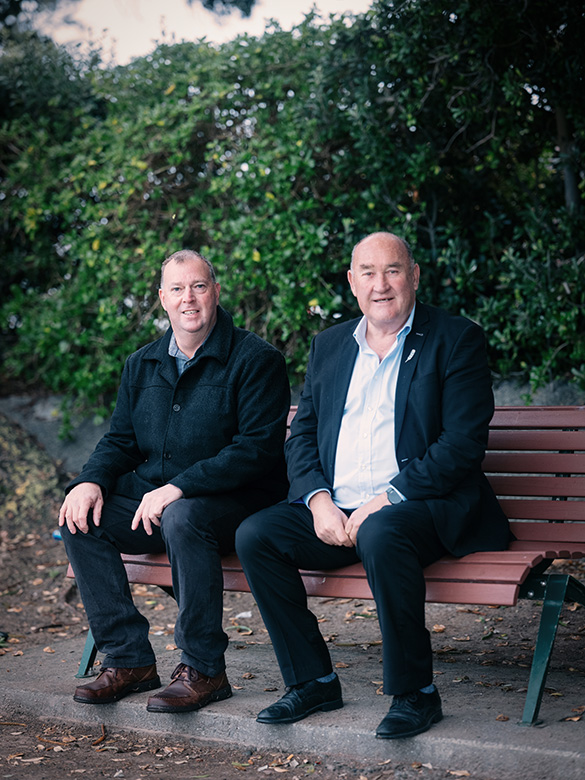
Councillor Keith Price, who has prioritised core water infrastructure during his tenure, says, “It’s all on the go but it’s a long project.
“I’d like to see more reservoirs put in and the treatment that goes on them – I’m talking about underground reservoirs. We are going to put in another couple of bores in Tareha Park. We have to put our bores in where they don’t get manganese [discolouration]. Our water has been rating pretty high on surveys now.”
The old Enfield Reservoir on Hospital Hill is being decommissioned, but only after two new 9-million litre water tanks are built. These will be filled with water from the Awatoto bore field and an inter-connector pipe will then join the new reservoirs on the hill to the Taradale reservoir, allowing for two-way transfer. If one reservoir site is out of action, the other will kick in, maintaining security of supply.
New bores are being installed at both Awatoto and Taradale, and a new water treatment plant will be built on top of the ones at Tareha Park in Taradale, to treat the water at source. “We need to bring them together and put a treatment plant on top of them. That will be in the Guppy road area of Taradale,” says Bond.
Yet another treatment plant will be built at the Awatoto bore field, but that will come later.
Furthermore, new rising and falling mains pipes will deliver water from the new bore fields up to the Hospital Hill and Taradale reservoirs.
Together these upgrades will bring Napier’s drinking water into compliance with the Water Services Act 2021, NZ Drinking Standards 2022, and Drinking Water Quality Assurance Rules 2022.
“It’s all about water treatment … So we need a little bit of filtering and that’s there to protect the UV that is going in, and that is what is going to provide the next level of treatment for Napier,” Bond says.
The city needs to be compliant by 2028.
New water services council-controlled organisation
All this is taking place as Napier, Hastings and Central Hawke’s Bay are merging the management of their water infrastructure.
Hawke’s Bay faces a massive water infrastructure bill, with three councils projecting approximately $1.25 billion in capital investment for drinking water, wastewater and stormwater services through 2033/34. What this means for individual ratepayers is a projected rise in water charges per connection from $1974 in 2025/26 to $3190 in 2033/34.
Keith Price, who sits on the advisory Shareholders Representatives Forum is “100%” behind the move. He’s also deputy chair of the Transition Governance Group, overseeing the handover.
“At the moment we are being transitioned … For the shareholders forum we need to select the independent chair of that. They’ll take over from the role I’m filling at the moment and I will stay on as a shareholder representative. All councils have three representatives and the company has three representatives as shareholders, but we won’t be doing the day to day running,” he says.
Under the new entity, water charges will be separate from rates. The council will collect that for the first two to three years, and then it will be taken over and rated by the new WSCCO. “I’m a great believer in user-pays and I liken it to electricity,” Price says.
However, Bond says a slow-down in project delivery during this transition is one of the risks he’s watching for. “I will actively be working with the transition team because it’s about getting all our staff into that organisation as smoothly as possible. It will be staffed by people already working on it. The goal of the councils is to make sure that everyone gets the same level of service on day one and that it is as seamless as possible.”
