


Last year, Hawke’s Bay’s Regional Economic Development Agency (REDA) commissioned an excellent review of the region’s telecommunications failures at the time of Cyclone Gabrielle, which clearly identified necessary resilience measures.
BayBuzz reported on the review in this 24 Sep 2024 article titled No mobile, no internet?!
Now, six months later, we’ve checked in to see what concrete improvements have been made to provide more resilient communications in the region.
Curiously, it doesn’t appear anyone in ‘official’ circles in HB is much aware of the practical work being done, let alone closely monitoring it from a public accountability standpoint.
REDA’s response to our progress query was that their role was simply “to speak strongly about the need to get this sorted”. But then what? We were referred to the HB Regional Recovery Agency (HBRRA).
HBRRA responded: “On the back of the review you refer to, the RRA, along with other regional stakeholders, have been actively engaging regularly with the Telecommunications sector on improving emergency resilience, both through our Infrastructure Working Group and directly. These discussions remain positive and constructive and aimed at arriving at concrete improvements in network and service resilience.”
OK, so folks are having chats (the hui), but what physical improvements have actually been initiated (the do-ey)? For that we were referred to the industry body, the NZ Telecommunications Forum.
Their chief executive, Paul Brislen, offered up this list of activities:
“We’ve upgraded batteries as per our regular business schedules (the three mobile operators do this constantly: batteries don’t last more than four or five years so they need to be replaced and they’re always better than the previous generation of battery).
“We’ve also increased our fleet of generators so we can now support more towers and cabinets than we could two years ago.
“In addition we’ve now got new software that enables remote power management of cell sites so we can limit what each site can support (so voice and text messages, not data) to reduce the load on the site should it be switched over to battery power. That extends the available life of the battery during an outage.
“We’ve upgraded our COWs (portable cell tower on wheels) so we have more of those and a number of them are able to use satellite for connectivity back to the rest of the network. This will be of huge use in events where backhaul is compromised.
“We’ve now got two MEOWs (mobile exchanges on wheels) which can be deployed to areas where exchanges are damaged. Each MEOW can switch up to 25,000 lines at a time and really are for use in situations where exchanges have been knocked offline by damage (earthquakes, tsunami for example).
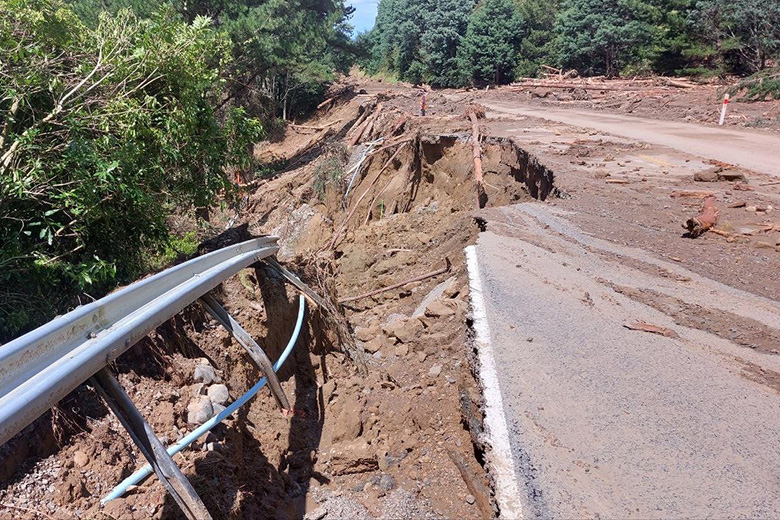
“In the Hawke’s Bay Chorus has been working to replace the fibre networks that were extensively damaged when roads/bridges were taken out during the storm. That’s ongoing because you can’t put the fibre down a road that hasn’t yet been built, so we’re still working to improve resilience in that regard. But the roads and bridges are being upgraded and replaced so that’s happening.
“We’ve also moved some of the fibre river crossings upstream of the bridges and elevated the fibre crossings, so they aren’t destroyed when slash from the hills takes out a bridge. You’ll recall around 80 or so bridges were destroyed across the region during the cyclone by slash crashing into the superstructure. That shouldn’t take out the fibre next time.
“In addition each of the mobile operators has signed up to partner with a low earth orbit satellite provider to deliver mobile-to-satellite connectivity. That means in future you’ll be able to text and even make voice calls even after if the terrestrial network is unavailable. That will help customers stay in touch during those difficult first few hours.”
Brislen then cautions: “The one thing we cannot do (and no network provider anywhere in the world can do this) is build a network that will withstand all the various natural hazards the country has on offer … There will always be outages, and no network can withstand all that New Zealand has on offer (slips, floods, landslides, tsunami, earthquakes, volcanoes, increased weather events and solar storms) but we strive to bring the networks back up and running as quickly as we can.”
All of the above sounds fine on its face … indeed impressive.
But still leaves open …
- Which public body or elected official in Hawke’s Bay is monitoring this progress and confirming to the public … ‘good enough … we’re on top of this’?
- Is the rebuild effort/investment properly balanced between adding capacity (in the industry’s commercial interest) versus deepening resilience (adding industry cost, not revenue)?
- Are there any logjams (figuratively!) or policy matters needing to be resolved that might speed up resilience work or make it more effective?
Brislen responded further:
“We can only do so much each year in terms of resilience and rebuilding. Largely any delays are due to working in conjunction with other network operators – we can’t build in ducts next to a road until the road is completed. We’d all like to do more, sooner but I think we’re doing as much as we could sensibly expect to.”
Fair enough.
He went on to mentioned keeping REDA, HBRRA and our ‘Lifeline’ group informed. While also noting: “Government can’t direct us to do much of anything, but we do listen to and engage with them on a regular basis.”
Then, when asked directly about local political accountability:
“I don’t know who is considered responsible from a council perspective. We engage with anybody that the council wants us to…”
Isn’t this work important enough to see that point of responsibility and public accountability clearly identified, just as it for civil defence and flood mitigation?

Accountability is important … and in this case, there’s a good story to tell so I wonder why it wasn’t being told before BB got on the case? Perhaps future council updates about progress on the roads and bridges will mention the comms and power improvements too.
Meanwhile, Starlink panels are popping up all over the place in rural HB, if not (yet) at the rural community hubs …
Nice to see that a lot of work is /has been completed/ongoing. Local councils should perhaps have one person whose responsibility is to keep the public informed of progress etc. using regular reports to the media and to field any queries from those looking for information