

Looks can be deceiving.
Our Regional Economic Development Agency (REDA) says that the construction sector contributes $924 million to the HB’s economy, supporting 10,440 jobs (2023 data), and reports solid growth over recent five- and ten-year periods.
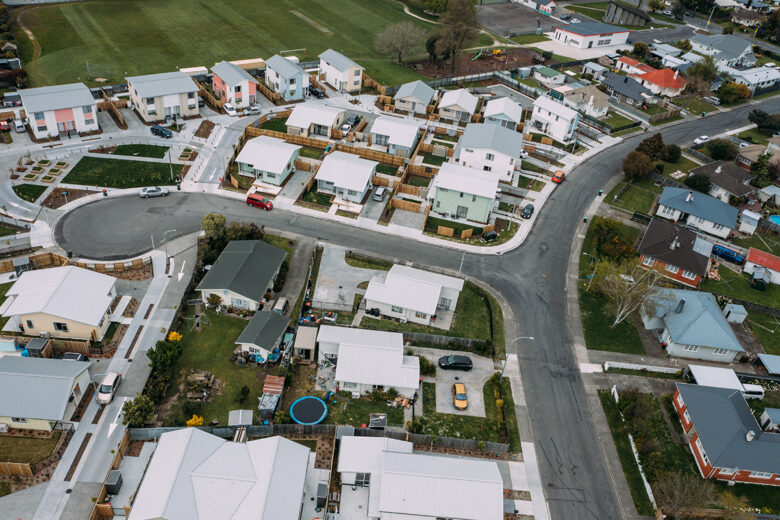
And driving around the Bay, there does seem to be plenty of construction underway, from multi-unit housings development to commercial scale projects (much of that, however, of the orange cone highway variety).
But insiders say that’s not the reality. Even the largest builders are laying off staff or low-bidding available work to keep their workforces as intact as possible. Those let go are generally the ‘last in’, such as newly credentialed apprentices. Many of those will head for Australia with little near-term work in sight in the local pipeline.
Smaller independent contractors are scrambling for the leftovers, mainly smaller scale home improvement projects.
Public housing construction has taken a big hit nationally with the Coalition Government stopping building Kāinga Ora houses and cutting $1.5 billion from the public house building and maintenance fund. Other public sector work (education, health facilities) has slowed as well as government agencies retrench.
A wave of caution is suppressing private new home construction and large commercial projects.
Two bursts of activity — post-Covid and post-Cyclone — were artificially created and have worked their way through the system, leaving behind over-capacity.
And so today the bottleneck is not workers or materials (issues in the past) but simply lack of demand. In Hawke’s Bay, heaps of sections are being readied in places like Havelock North’s Middle Road and above the Mission in Taradale, with other contentious developments in Napier proposing nearly 2,000 homes, but it’s not at all clear who the customers are that will be looking to build on them.
REDA recently reported ‘House construction’ as generating $107 million in value in 2023 (year of the cyclone), matched only (by the same amount) for ‘Road & Bridge Construction’.
Latest national statistics indicate 33,595 new homes were consented in the year ended February 2025, down 7.4% from the year ended February 2024.
In HB, figures obtained by BayBuzz from the Hastings and Napier Councils indicate a mixed bag with respect to building consents, with the outlook not looking good.
In Hastings, commercial consents were down 15% in number and 41% by estimated value in calendar 2024 compared to the previous year. However residential consents were up 11% in number and 14% by estimated value.
With only three months of data so far in 2025, this year’s consents appear far off the pace of last year in both categories.
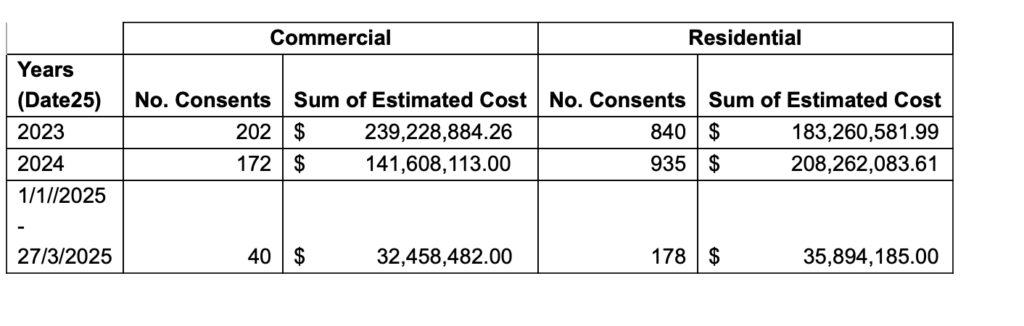
Napier’s data indicates the reverse, with commercial consents up 13% in 2024 and residential down 6%. But here again, figures for the first three months of 2025 show this year dramatically off the pace of last year.

Altogether the Hastings and Napier building construction on the consent books, residential and commercial, amounted to $561.9 million. But apparently not enough to keep everyone busy.
REDA’s report projects regional employment in construction to contract less than 1% between 2024 and 2029 (about 400 jobs). It asserts there is “a significant pipeline of infrastructure investment and construction effort required” to support the sector”. And further: “Hawke’s Bay has a good base of established local residential, commercial and industrial construction firms.”
Today at least, both those comments would appear to be a bit rosy. Industry folks are frustrated over the lag times delaying public sector projects, which threatens the cash flows of even the biggest players. And we’ve heard from no one in the sector who isn’t making or contemplating worker lay-offs.
The most optimistic view? It’s just a cycle … they come and go. What do you think?

As someone who has worked in the industry based mainly around residential new builds for over 20 years, I see the demand is driven by immigration and as long as we have net migration growing, we see the need for more whares and as migration drops away so too does the demand.
That is not to suggest we need more migration as that leads to other problems as infrastructure such as roading never seems to keep pace with development, with Auckland’s never-ending congestion and even our own as seen on the “Expressway” as obvious examples. Add in the increased demand on the 3 waters (sewer, drinking and storm) which our councils and therefore ratepayers are struggling to maintain let alone advance with the systems being used having been designed and built for far less demand than they are now expected to support puts us behind the 8 ball yet again.
It is more a case of balancing immigration with industry and whilst there may be calls from some in the business community of “we need more people” etc with justifications of “economy of scale” and other catch phrases, the reality is many other countries with higher populations are experiencing declining economies as we see in the EU/UK/US etc and that is not just a recent trend.
NZ is unique in many ways and rather than “follow the pack” as we have done for years, perhaps we could do better with improved long term planning by central Government with a clear vision and focus on where we want to be in 20/30 even 50 years time, not just in the next 5. That may well take a change in the way our political parties think with a more collaborative approach that plays the long game bound to be an improvement on the way they have operated for decades.