

The Government’s latest ‘Situation and Outlook’ report for the primary sector (SOPI) was just released, painting a rosy picture of NZ’s agribusiness status and potential.
This SOPI forecasts food and fibre export revenue, which accounts for 82.5% of NZ’s goods exports, to reach a record $59.9 billion in the year ending 30 June 2025, rising to a further record $65.9 billion in the year to 30 June 2029.
Here are the sector headlines, with meat/wool, horticulture and forestry being most pertinent to Hawke’s Bay.
- dairy export revenue lifting 16% to reach a record $27 billion
- meat and wool export revenue increasing 8% to $12.3 billion
- horticulture export revenue growing by an impressive 19% reaching $8.5 billion
- forestry export revenue jumping 9% to $6.3 billion
- seafood export revenue lifting 2% to $2.2 billion.
And here’s the detail on where our food exports go.

The report did issue this caution:
“Lower global energy prices are likely to reduce imported input costs for New Zealand’s food and fibre sector, leading to lower production and transportation expenses. However, rising global fertiliser prices in the short term may continue to drive up production costs for New Zealand farmers and producers, potentially offsetting some of the advantages of cheaper imported energy. Decreasing global food prices in the short-term outlook may also lead to lower returns and margins for some New Zealand exporters, especially those exporting bulk, undifferentiated products.”
SOPI always emphasises export revenue. And our food exports are currently enjoying very favourable pricing and currency conditions. So we’re generating exceptionally high revenue off the volume we are producing.
What gets less headline attention is the actual production levels that earns the revenue. And for our meat and wool exporters, the production future is not so rosy. As this chart indicates, beef cattle volumes are predicted by SOPI to be flat over the next five years, while the country sheep flock is in steady decline.

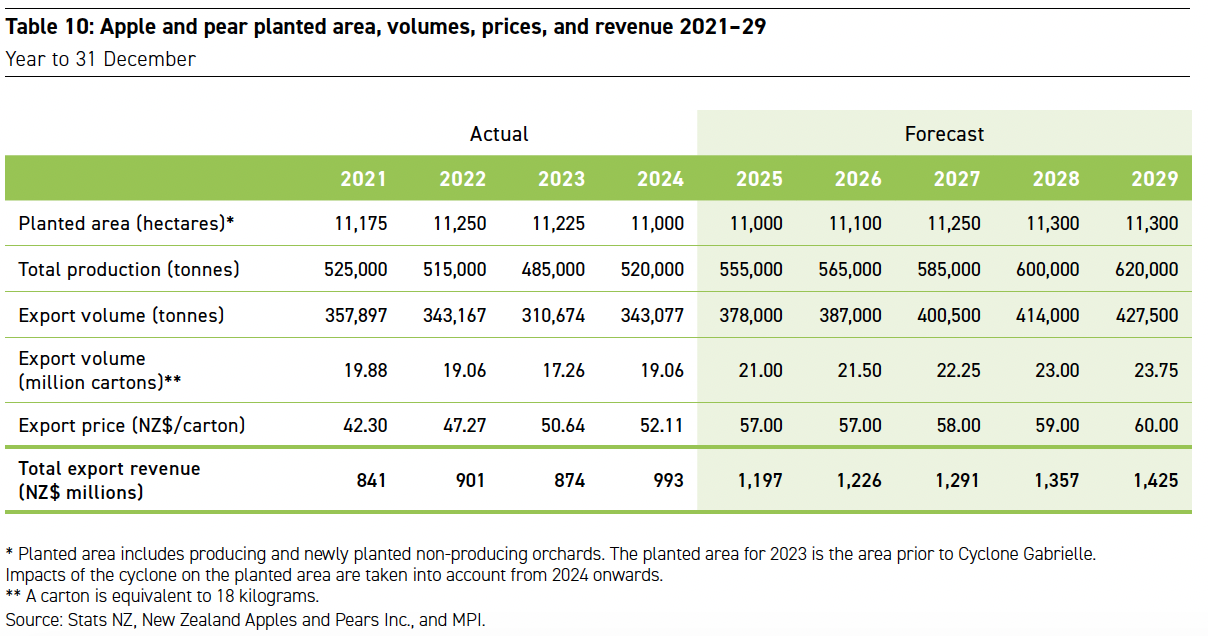
No one is suggesting these trends will reverse. It’s tough to see how flat or lower volumes can sustain the high revenues currently enjoyed. Forest harvest volumes are also flat. Only horticulture is predicted to grow, with apples leading the way, happily for Hawke’s Bay, but even there volume growth is predicted to be modest.
SOPI is also eager to see more irrigation, including on-farm water storage. NZ presently has about 900,000 hectares irrigated; the report says 300,000 more could be added.
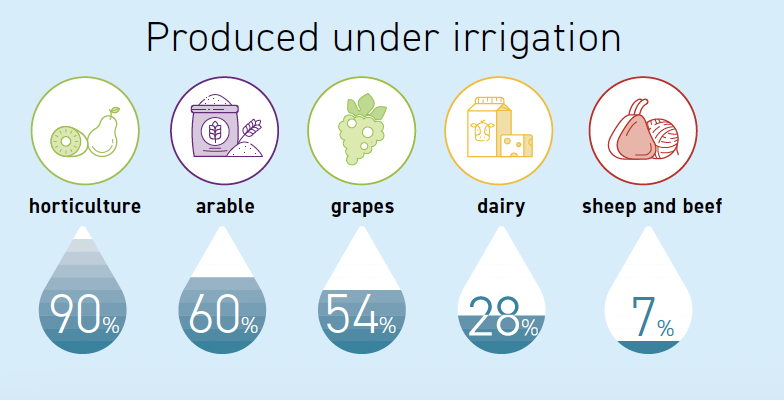
Hawke’s Bay currently has 28,804 hectares irrigated, half of that evenly divided by fruit and sheep & beef.
You can download the full report here.
