


[As published in September/October BayBuzz magazine.]
Engagement exhaustion ahead?
Our councils are preparing some really heavy lifting in the months ahead, and much of that will involve public engagement around major infrastructure challenges – flood protection across the region, a Coastal Hazards Strategy, ‘3 Waters’ investment and service delivery, and a Napier-Hastings Development Strategy.
Decisions made in these four areas will direct the investment of hundreds of millions of dollars over the coming decade and beyond, as well as dramatically shape our physical landscape.
BayBuzz has been reporting regularly online on these decision-making processes in bits and pieces. Here I try to give a better sense of the full scope of critical issues ‘in play’ affecting our region’s future.
The significance of these decisions requires major public engagement … and indeed raises the threat of ‘engagement exhaustion’.
Flood protection
‘Flood protection’ to many residents refers to protecting homes, businesses and lifeline infrastructure from river and stream flooding, as per recent severe weather events.
But more widely, it intersects with our broader civil defence preparedness and immediate response to any natural disaster. Our region’s latest weather challenge triggered a handful of reviews that exposed shortcomings that would just as likely have crippled our response to a major earthquake or tsunami. So in that sense, the civil defence and emergency management lessons that now must be actioned have wider applicability to our future security.
On the flooding front, the Regional Council received in July a very comprehensive independent 250-page flood review (from a panel led by Dr Phil Mitchell) of its Cyclone Gabrielle flood management. As Councillors noted, its analysis and 47 recommendations become the accountability standard against which to measure the sufficiency of HBRC’s future remedial actions.
Perhaps the most strategic message delivered by the Report is that stopbanks can offer only a limited degree of protection, and get us by in many situations, but in such severe events they will not suffice. And so the challenge becomes managing the flood overflow as safely as possible – from the upper reaches that will first be breached down through flood plains to the sea.
This new approach must be imagined and designed with all community stakeholders, as it involves decisions about pathways, property rights, risk allocation and priorities. The Report noted: “The key strategic arrangement of the catchment system needs to be based around the evolving global best practice of ‘Making Room for the River’ and ‘Natural/Nature Based Solutions’…”
The Report also argued HBRC should be empowered to instruct councils where not to build!
Then in August HBRC received from consultants Tonkin + Taylor its first pass at the range of options that might be considered to manage flood events on the Heretaunga Plains and the Upper Tukituki (available here).
In both cases, much more is on the table than simply more or higher stopbanks. Similar investigation and option analysis has occurred to address Wairoa’s situation.
With respect to the Heretaunga and Upper Tukituki schemes, Tonkin + Taylor has so far examined the present infrastructure in detail, reviewed the actual breaches and flooding that occurred, identified a range of potential system improvements and modelled the effectiveness of those in various flood scenarios.
Council and consultants alike are emphatic that the advice presented was early stage, requiring more technical review, Council direction and community engagement.
Key takeaways from the presentation …
• Changes must be made in a holistic framework, meaning that a ‘fix’ at one location (such as raising a stopbank or installing an additional one) will change the flooding behaviour and effectiveness of the system elsewhere. Planning must constantly be looking at the big picture.
• Yes, bridges were a major obstacle exacerbating flooding, and their design must be addressed, but modeling shows that even without bridges the intensity of rainfall would have caused major overtopping. [As many other observers have noted, the issue is woody debris + bridges.]
• The blocking of waters at the converged mouth of the Tūtaekurī and Ngaruroro Rivers requires major rethinking of river mouth management. Likewise the railroad and highway bridges at Awatoto represent huge flow barriers at that location. It was emphasized that in this event both these rivers peaked at the same time, exacerbating not only these choke points but obviously every structural protection in the system.
Beyond such broad strokes, Tonkin + Taylor picked apart each of the rivers section by section, indicating the types of specific interventions that could be considered and their various impacts – raising stopbanks, new and/or secondary stopbanks, spillways, ponding areas, connections to drainage systems, stopbank design and surface treatment … and in the case of the Ngaruroro, perhaps widening of the river course.
What next?
Regional Council staff propose the rest of 2024 be devoted to further analysis and sorting out how to engage both the community at large and its many interest groups. Then 2025 would be devoted to working toward community understanding and stakeholder buy-in for various options. 2026 then devoted to governance and funding issues, decision-making around these, and translating all that into LTPs due in 2027.
Hopefully some low-hanging fruit will be identified so that visible progress can be made while more complex deliberations around optimal interventions, risk tolerance and funding can occur.
Meantime, former mayor Lawrence Yule has been appointed Crown Manager to oversee joint development of flood mitigation plans by HBRC and the Wairoa Council and other local stakeholders. He’s been given 18 months to get things sorted up there.
With respect to Civil Defence and Emergency Management, reviews and recommendations have been completed at both the regional (Mike Bush report) and national (Sir Jerry Mateparae report) levels in response to last year’s weather disasters. The excellent Bush review went from big picture to deep in the weeds and produced 75 recommendations. Both reports stressed the need to better tap local knowledge and to engage the community seriously in response planning and execution.
Our Civil Defence Emergency Management (CDEM) Joint Committee, consisting of the region’s mayors, HBRC chair and iwi reps, supported by CDEM staff and councils’ chief executives, is overseeing CDEM reform initiatives, a number of which have begun. For example, development of 31 community and marae hubs across the region with work on a further 40 progressing. Operational capability has been enhanced with 312 council and partner staff across the region attending emergency management training.
CDEM has appointed HB-based John Hamilton as Independent Advisor for this work. The appointment is intended to bring a senior experienced outside view to redesign and implement the HB civil defence structure and activities and hopefully restore community confidence in regional and local emergency management.
Mr Hamilton has served as Director of the Ministry of Civil Defence & Emergency Management (2006-2014). He was appointed National Coordinator for the response to the 2011 Christchurch earthquake and was responsible for coordination of the national response and for implementation of recommendations made in the post-earthquake review of the response. Prior to his civil defence experience Mr Hamilton served 35 years in the Royal NZ Air Force.
Coastal Hazards Strategy 2120
After some ten years of technical analysis and public engagement with coastal residents, iwi and other stakeholders, a Hawke’s Bay Coastal Hazards Strategy has been delivered, looking ahead at mitigating climate change impacts over the next 100 years.
Under the auspices of the Clifton to Tangoio Coastal Hazards Strategy Joint Committee (yes, another Joint Committee), huge amounts of technical information have been served up for councils and residents to acquire and absorb – predictions of future conditions, pros and cons of a full range of interventions and their costs (including planned retreat), agreeing on the decision-making framework and ‘triggers’ that would guide ultimate choices and the ranking of their priority of implementation.
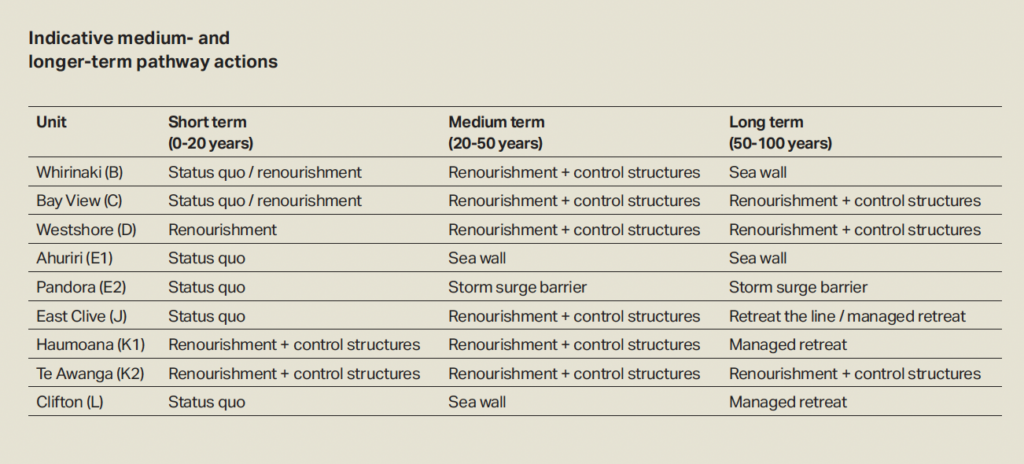
The proposed scheme is built around nine priority coastal locations from Clifton to Tangoio, each with its intervention plan, timetable and costs. The plan is designed to be adaptive, recognising that the degree and pace of climate change impact is uncertain.
Of course, apart from selecting the most efficacious interventions to protect each ‘cell’ and prioritising their implementation, the bottom line issue becomes, who pays?
The strategy proposes:
• 70% of the cost to implement the works are proposed to be met by all properties within the unit. These costs are then allocated to individual properties based on three categories being high, medium or low risk of inundation.
• 25% of the cost to implement the works are proposed to be met by the relevant council (Napier or Hastings), as the works preserve the value of council amenities that are close to the unit.
• 5% is allocated to the whole region (including Wairoa & CHB), as there are assets that benefit the entire region that will be protected by the Coastal Strategy works.
This approach puts the main burden on the property owners most directly affected, with the wider rate paying community contributing on the basis that essential community assets (roads, reserves, wastewater treatment plants) must be protected as well.
Unknown at this time is the extent, if any, to which the Crown might ultimately come to the party with funding. That decision must be taken with a view of the costs of protecting NZ’s entire coastline (or at least its built portions) and the assets sitting on them.
In its first assessment of NZ climate adaptation planning, released in August, Climate Change Commission Chair Dr Rod Carr notes: “Adapting to a changing climate is different for each individual community – it is an inherently local issue. Central government can provide a way forward by giving communities the tools they need to make their own choices. Supporting councils as they plan and take action with their communities to live with the impacts of climate change is a key issue that needs to be addressed as soon as possible.”
A Local Government NZ report put the cost of endangered councils’ assets alone (i.e., not including private or central government) at up to $14 billion. The Hawke’s Bay risk was put at $1.2 billion, third-highest in the country.
Implementation of the strategy has been delegated to the Regional Council, and relevant HDC and NCC coastal assets will be transferred to HBRC. Consultation on this strategy will occur early next year, aiming for completion by March. The chart above summarises an amazing amount of background data and community vetting.
In the meantime, more urgent ‘immediate actions’ have commenced with beach renourishment at Bay View and Westshore, as well as groyne construction to help capture and hold in place shore gravel in Haumoana and Te Awanga. Triggers have been identified for ‘short term’ responses for Whirinaki, which also faces losses from erosion and potential coastal inundation.
‘3 Waters’
The current government calls this area of infrastructure planning ‘Local Water Done Well’. But ‘3 Waters’ more clearly describes what’s at stake – how to fund and build reliable, safe infrastructure to deliver our drinking water, wastewater and stormwater services.
The government has announced a model where local councils will create a separate Council-Controlled Organisation (CCO) empowered to borrow to fund water infrastructure so that this borrowing (and rating) is undertaken separately from the councils.
This will give our local councils more headroom to themselves borrow more to fund other council priorities and projects.
The new CCOs will borrow from the existing NZ Local Government Funding Agency, an entity that councils now use for borrowing at slightly below private market rates.
Says Local Government Minister Simeon Brown: “LGFA has confirmed it can immediately begin lending to water CCOs that are financially supported by their parent council or councils. (Editor: emphasis added.) LGFA will support leverage for water CCOs up to a level equivalent to 500 percent of operating revenues – around twice that of existing councils – subject to water CCOs meeting prudent credit criteria. This will enable councils to better manage debt and make essential infrastructure investments without drastic rate hikes.”
Basically that means the new entities can borrow up to five times their revenue, that revenue to come from water users — irrigators, businesses, you and me.
Obviously, funding water infrastructure – with up to 80-year asset life – via borrowing is the prudent way to distribute the costs of these assets across generations of ratepayers. So yes, current ratepayers will pay less now than if all these costs were immediately loaded onto today’s rates. But this is the way all councils’ capital investments are normally funded. Nothing new here.
What is new is facilitating the creation of these new entities – the water CCOs – to do the borrowing … and levying the rates to pay for the borrowing and service costs. So again, yes, you will be paying an additional rate for your water services, most likely to a new HB regional entity.
Government regulations will ensure that water revenues are ring-fenced. That said, with our councils given more headroom to borrow for their (non-water) projects, we’ll need to watch carefully how that ability is used. Maybe less peace of mind on that score.
HB’s four mayors have delegated to the HB Regional Recovery Agency the task of shaping HB’s version of a water CCO that would potentially integrate the provision and funding of water services across the region.
While a regional approach seems a no-brainer, it’s not a foregone conclusion.
Hastings Mayor Sandra Hazlehurst says whilst it’s heartening to know we are on the right path undertaking this joint work, it is important to reinforce that no commitment has been made to adopt a regional solution. “We will need to carefully consider all viable options as we progress this important mahi.” Mayor Craig Little adds: “We absolutely want our communities to have a say on whether a regional water services model will best serve their needs.”
More community consultation!
Napier-Hastings Future Development Strategy (FDS)
This strategy, prepared as required under the National Policy Statement-Urban Development by the Napier, Hastings and Regional Councils, prescribes where housing will be built and industrial land provided on the Heretaunga Plains over the next 30 years.
The FDS Joint Committee’s preparation of the draft strategy has been guided by extensive consultation with interested landowners and developers, mana whenua, relevant government agencies (e.g., Transport, Education) and infrastructure providers like power and communications.
This has yielded a ‘preferred spatial scenario’, which takes into account broader factors like natural hazards, environmental concerns, transportation impacts and the need to preserve vital primary production land.
During the 30-year planning window the Napier /Hasting population is projected to grow by over 40,000 people from 2023 levels.
As a general principle for the entire urban region, the strategy strongly emphasizes intensification over greenfield development. A ‘total demand’ for 16,320 dwellings is projected, 6,700 in Napier and 9,620 in Hastings. New greenfield development is limited to 3,520, 62% of those in the Hastings district.
A number of large areas have already been zoned or consented for urban development, or where development has already commenced. These are considered to provide adequate capacity for short-to-medium term new greenfield housing, including: Mission Hills (800 dwellings), Te Awa (615), Parklands (320), Wharerangi Road (350), Wairatahi (460), Brookvale Road (550), Howard Street (350), Iona (350), Lyndhurst Stage 2 (140), Other (275).
The preferred scenario provides only limited opportunities for new greenfield expansion in Napier, given land in its urban area is “generally low-lying, vulnerable to land subsidence and rising groundwater levels, and a range of other natural hazards.”

As for industrial land, Napier has about 60 hectares of undeveloped land (majority around the airport) and Hastings has about 200 (Omahu Road, Irongate, Whakatu and Tomoana). The strategy deems this as sufficient for projected demand over the long-term.
All of the draft strategy and supporting information is available online in excruciating detail and well-illustrated by maps.
Assuming participating councils approve the draft, it will be the public’s turn to comment. More consultation: Is this the urban growth you want to see, and where you want to see it?
The public engagement window is slated for four weeks over Sep/Oct, followed by hearings. Optimistically, the staff paper projects final approval by councils in December 2024.
As you’ve now read, a heap of public engagement is on the Hawke’s Bay agenda over the next 6-7 months. From traditional submissions processes and stakeholder vetting to yet-to-be-invented participatory mechanisms … possibly even ‘citizen assemblies’.
All of this will place major time and resource demands on both councils and the interested citizenry … potentially consultation overload, the topic I’ve discussed in this edition’s From the Editor.
