


Parliament’s cross-party Finance and Expenditure Committee recently reported back on the proposed Water Services Entities Bill.
BayBuzz has been a steady supporter of the Government’s reform proposal.
The bill establishes four publicly-owned water entities, ostensibly to deliver more cost-effective, safe and efficient water services, through improved investment and management.
As reported by Committee, the Bill expands the controversial ‘Three Waters’ reforms to include coastal and geothermal waters.
The relevant explanation reads:
“In the bill as introduced, Te Mana o te Wai statements would only apply to freshwater bodies. However, water services also discharge into coastal water, and may affect geothermal water. We believe it would be appropriate to expand the bill’s application of Te Mana o te Wai to these other water bodies.
“This would be consistent with te ao Māori (the Māori world view), which does not distinguish between applying the concept to freshwater or coastal water. We also consider that Te Mana o te Wai statements should apply to all water bodies, and WSEs should give effect to these statements.”
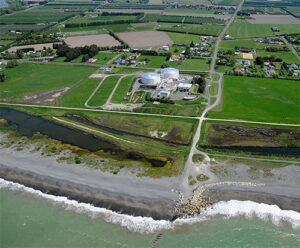
How might this affect our region?
It is logical that the principles of Te Mana o te Wai would apply, for example, to discharges into the marine environment. There’s very little likelihood that Hastings and Napier will get new consents to dump ‘treated’ wastewater into the Bay.
Nonetheless, the Committee recommendation to expand the scope of the Bill does add fuel to the fire for those opposed.
“The Government has not made any significant changes to improve its broken Three Waters model. The Bill that has come back to Select Committee today shows Labour still isn’t listening,” said National’s Simon Watts.
ACT’s Local Government spokesman Simon Court said: “Labour is continuing to bulldoze through its wildly unpopular Three Waters policy, despite New Zealanders overwhelmingly rejecting it.”
BayBuzz asked Napier Mayor Kirsten Wise, who is on the record as being opposed to the reforms, what she made of this significant expansion of the Bill and what the implications might be.
She said she remained opposed to Bill in its current form and had been working with other mayors both regionally and as a member of Communities 4 Local Democracy to share their concerns with central government and advocate for an alternative model.
“There will absolutely be a number of questions in respect of the proposed expansion to include coastal and geothermal water and I will be discussing this with our councillors and also other mayors around the country,” Wise said.
Local Government Minister Nanaia Mahuta thanked the committee for its consideration of more than 80,000 submissions, and welcomed its recommendations. “As the result of listening to public submissions, extensive changes have been proposed,” she said.
The Government is determined to push the Bill through, with the second reading passing on 16 November, mere days after the committee’s report came back. Labour and the Greens had voted down a motion to extend the report back date by a further six weeks to allow time to consider alternative proposals.
National’s Simon Watts complained that conciliatory noises made by Prime Minister Jacinda Ardern and Minister Mahuta after alternative water reform proposals made by a coalition of three mayors were put on the table — that they would “consider matters raised”, were “open to making refinements”, would consider the alternatives “in good faith” — were in the end nothing but lip service.
In his view, rather than listening, the Government had instead made the Bill worse.
In reality, there has been no shortage of consultation, and indeed local government is divided on the matter. But, like it or not, this train has left the station.
Public Interest Journalism funded through NZ On Air.

it’s not about broken pipes and infrastructure; it’s about Maori self-determination via ” co-governance” giving Tainui Mahuta and her ‘brown table’ cohort control of water, seabed and foreshore Part 2….it’s that simple and it’s not racist to state the facts..
Absabloodylutely
Agree with Rob that “it’s nothing to do with infrastructure and supplying water”. It is simply convenient for many (including Cr Kirton) to refer to flooding in Napier (Nov 2020) which was almost entirely due to short comings and failures with NCC pumping equipment to justify the Govt and Iwi, taking control of water. The Govt could justify controlling the HB gravel coast after what HDC has done with isolated hard engineering between Clifton and Clive and what HBRC and the Port have done to beaches from Hardinge Road to Whirinaki (with NCC support). Rather than rely on and allow the Govt to takeover – we need to apply local knowledge of coastal processes and reinstate coastal protection to restore resilience to climate change for all beaches between Hardinge Road and Whirinaki – just like the coast between Awatoto and the Marine Parade which is not subject to the HBRC Coastal Strategy or solutions to address SLR. After 9 years, many $millions and numerous reports to address SLR due to ‘climate change’, HBRC had Tonkins determine property and public assets valued at $2 billion are subject to ‘retreat’ due to coastal erosion from SLR. A certain disaster with major losses would not be an issue if natural coastal sediment that drifts north by longshore currents had not been trapped by the Port shipping channel since 1973. After 17 years and many detailed Submissions, the HBRC and the NCC will not restore these beaches to the constant state of accretion that existed up to the mid 1970’s – so who will?
In Central Hawkes Bay the local council this year has under its watch had two leaks of wastewater one being raw sewage clearly they are not up to the job and their opposition is just out of self interest , something has to happen to protect our rivers from their mismanagement.