


[As published in January/February BayBuzz magazine.]
In recent years, Hawke’s Bay has not lacked for ‘big ideas’. Some came to fruition, others not. Some died, but could be revived.
And now there’s a raft of new ‘big ideas’ as well, as you will be reading throughout this edition of BayBuzz.
For this article, I’m thinking of ‘big ideas’ as those requiring a considerable amount of resource and/or public buy-in … and offering considerable change to the Hawke’s Bay ‘landscape’ in one manner or another. Sometimes with disputed benefits.
What have some of these been? What new ones are in the pipeline? What gets a ‘big idea’ across the line?
The past
Lawrence Yule wanted a sports park. He got one, effectively trading some real estate and an antiquated stadium adjoining Hastings CBD for some farmland at the Expressway.
There was opposition. Some believed the money could be better spent on community facilities around the district; some worried that big box retailing would suck customers away from CBD retailers; others wanted to protect versatile farming soils.
It didn’t help that initially the spear carrier for the proposal was Sam Kelt. But he was supplanted by super-sport advocate Sir Graeme Avery and the HB Sports Park came to fruition … and is now one of the region’s prized and most-used assets, including as a venue for national and international sport competitions.
Avery didn’t stop there. He had an even larger vision for a fitness centre catering to both (potentially) elite athletes in the region as well as the physical wellness of the community at large. Millions were raised to build what is now the HB Community Fitness Centre, including the state-of-the art Regional Aquatic Centre, serving both Olympic level competitors and everyday lap swimmers.
The facility delivers what its website promises: “We deliver a spectrum of services from community health and fitness, athlete development, and high performance sport – all under one roof. Our aim is to improve the health of everyone in Hawke’s Bay, as well as grow future Olympians, right here in our own backyard.”
And in snuck Bruce Mactaggart, driving establishment of the world-class field hockey turf as part of the complex.
But Avery wasn’t focused entirely on sport. Along with Kim Thorp and Rebecca Turner, he championed a pivotal positioning for the region – Hawke’s Bay Wine Country (perhaps to the consternation of the ‘Fruitbowl’ advocates). That appellation steadily gained traction, and drew more and more visitors, until recently achieving the region’s recognition as a Great Wine Capital of the World, one of just 12 premiere wine districts in the world, and the only one in NZ.
Another ‘big idea’ connects many of the wineries on which that recognition is based – our robust cycling network, starting with Hawke’s Bay Trails in 2002, whose tentacles have spread out some 200 kilometers since. The original vision came from then-Mayor of Napier Barbara Arnott, aiming to create a local seaside pathway … a vision pedaled forward by the Rotary Pathway Trust.
Another seaside vision was not so fortunate. Andy Lowe championed a plan for a massive housing development, some 900 or so homes, at Ocean Beach, which was initially supported by the Hastings District Council.
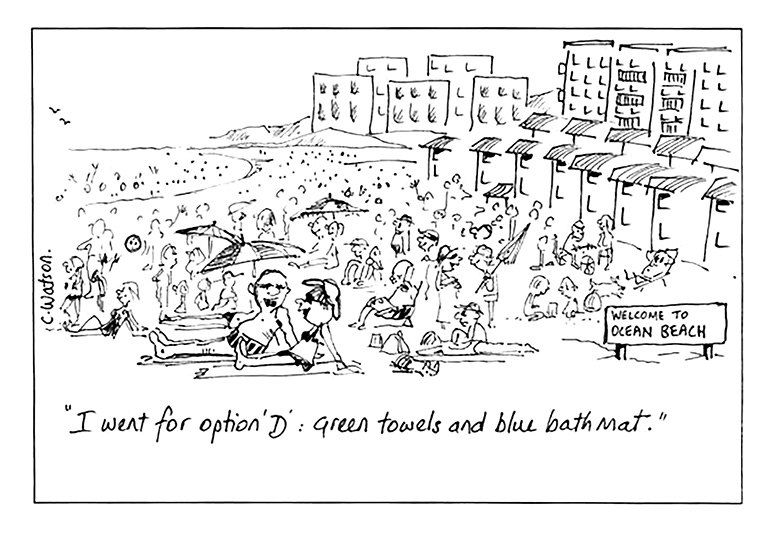
However, the project ran aground in 2008 when a citizens’ campaign, Friends of Ocean Beach, generated over 10,000 names in opposition, complementing a barrage of substantive submissions from the likes of Future Ocean Beach. HDC backed away and the plan was withdrawn.
Lowe, in partnership with the Robinson and Hansen families, then channeled his Ocean Beach energies into the establishment of 2,500 hectare Cape Sanctuary, which has become a highly successful conservation initiative. Not without controversy, but with the steady hands-on support from hundreds of local volunteers, Cape Sanctuary, home of the legendary 10.6 kilometre predator-proof fence, has become a regional and national asset focused on bird, animal, plant, tree and dune restoration.
In 2012, another ‘big idea’ was born – the Hawke’s Bay Foundation. Rebecca Turner was the driving force. An original donor relates, “She had the vision, she cajoled, she persuaded, and put together a team of ten major donors to act as the example to the rest of the community that it was an idea worth supporting.”
The concept is worldwide and simple. Pool money through donations and bequests, invest it carefully to preserve the endowment, and commit the earnings to deserving community organisations and initiatives. Generous individuals of course do this personally through trusts, but the idea here is to both pool funds and upgrade their management to make significant grants of broad HB community benefit.
Twelve years later, the HB Foundation has recently awarded $366,000 to 65 local recipients, assisting sectors ranging from health, education, the environment, Te Ao Maori, youth development and arts and social services.
Three blockbuster proposals rounded out the ‘teens’ decade. The first two failed.
Amalgamation of the region’s five councils was hotly debated in the 2014 – 2015 window, with a referendum deciding the matter in September 2015. The proposal, championed by then-Mayor Lawrence Yule and a community group led by Rebecca Turner, would have consolidated our five councils into one region-wide unitary authority, with community boards for CHB, Hastings, Napier and Wairoa. Each of four districts had to approve the measure, and only Hastings did (by a bare 51%). Across the region, the vote was 66% against, 34% for.
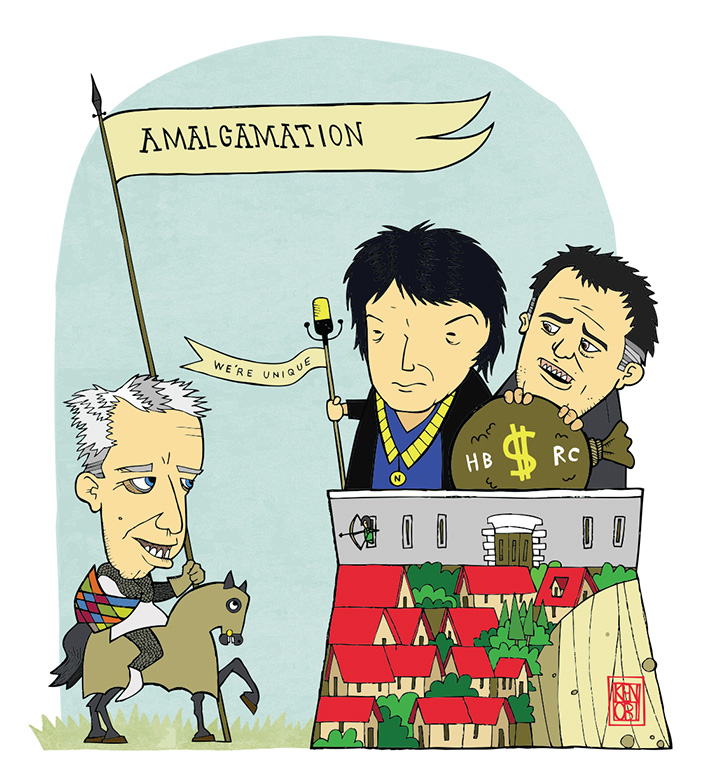
It took the Ruataniwha Dam (or at least the first attempt to build it) longer to die. The dam, costing $300m+ to construct and even more to distribute its water, was sponsored by the Regional Council via its Regional Investment Company (HBRIC). The project built momentum through the 2013-15 term of the Council with dam proponents in the majority and receiving approval from a Board of Inquiry in 2014.
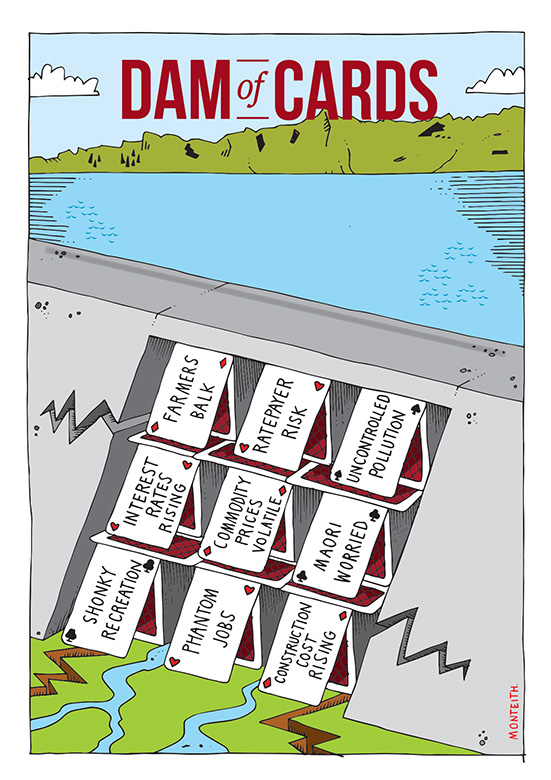
But the scheme eventually faced opposition from a majority of councillors elected for the 2016-19 term while failing to attract financing or a required level of prospective water purchases. A Supreme Court decision in 2017 blocking the flooding of conservation land behind the proposed dam was the last straw, with HBRC abandoning the cause having spent some $20 million on it.
In a way, cessation of the dam quest allowed attention to shift to another major project during the 2018-19 window. Napier Port sorely needed capital to increase and modernise its capacity. A plan was put together by HBRC Chair Rex Graham and the Port team to publicly list the Port and offer a minority (45%) of its shares for public sale, the majority to be retained by HBRC.
With the port officially a strategic public asset, extensive public consultation was required and carried out. With broad public, business and union support, the proposed listing and sale went forward in August 2019. The IPO yielded $234 million, for construction of a new, large, modern wharf (6 Wharf) and additional port working capital and financing capacity, plus a $107.9m contribution to HBRC’s balance sheet. There appear to be no regrets on this one.
Meantime, Rocket Lab had launched its first rocket from Mahia in 2017 through the drive of one innovator/ entrepreneur – and now billionaire – Sir Peter Beck.
So here is a ledger sheet of sorts to the present day.
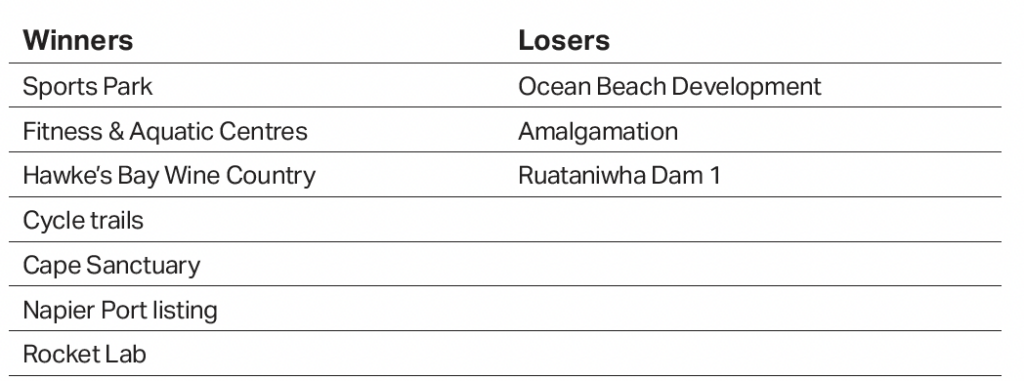
What next?
Let’s assume the ‘winners’ above continue in their successful ways. What might be built upon those?
Let’s start with some former losers.
The most obvious ‘re-start’ is Ruataniwha Dam 2, for which proponents secured fast-track status in the government’s new legislation, as well as up to $3m from the new Regional Investment Fund, which must be matched by dam sponsors, to establish the environmental and financial feasibility of the born-again scheme.
Empowered by the fast-track legislation, it is assumed the government will override the Supreme Court blockage of Dam 1. The new law also gives explicit priority to economic over environmental considerations, so, although a Special Panel will need to confirm the project, it effectively cannot be blocked on environmental grounds, which isn’t to say a pitched battle for public ‘hearts and minds’ won’t occur over the environmental issues involved. It would appear that the fate of Dam 2 lies in selling its economic and financial viability, yet to be established.
Ruataniwha Dam 2 is right in our face. Simmering more quietly is the issue of amalgamation, an issue often raised in response to BayBuzz’s invitation for ‘big ideas’.
Although our five councils have been playing more nicely together lately than they were during the amalgamation debate window years ago, with Hastings and Napier in pitched battle, arguably the case for amalgamation has steadily become more obvious. Our five councils increasingly struggle with costs and issues that are patently regional in scale – weather resilience, civil defence, water services, coastal protection, land use and urban development, and overall cost/unaffordability of services.
And coming to a boil in 2025 will be ‘3 Waters’ reform (or ‘Local Water Done Well’ as National puts it). Here in HB work is underway (budgeted at $1.33m) to devise a scheme that would place delivery and funding of drinking water, stormwater and wastewater services under one new regional entity.
How this entity is structured and governed, what its investment and operating costs will be, and how those will be shared and funded across the region will be challenging questions for our local decisionmakers across councils to decide … and secure public buy-in to. But the die is cast, the government is demanding this outcome, expecting a plan for the region by August 2025, but offering no financial support for the huge investments ahead.
This article isn’t the time and place to litigate Dam 2, amalgamation or water services reform, but you can reasonably expect the debate (and BayBuzz coverage) to escalate over these three in the coming year, which of course includes an election.
Which brings us to the first of several ‘new’ big issues to contend with.
The October ballots will include referenda on Māori wards for four of our councils. Virtually all of our current local elected politicians – led by three of our mayors and our Regional Council chair – are vocal champions of Māori wards. However, it is not at all clear that a majority of voters are … and let’s be frank here, pakeha voters.
Again, this isn’t the time and place to litigate the issue. But when candidates must put up their hands in July declaring their intentions to stand, they will be grilled on their positions on Māori wards, and the public discussion will begin in earnest.
The rest of the ‘big ideas’ I’ll mention here are pretty much stolen from the voices BayBuzz heard from when we invited ideas from our readers.
Each requires details to be developed, pros and cons to be debated, and leadership if any are to be realised.
Flood resilience
With technical analysis completed, options for protecting HB communities from future severe weather event flooding will be floated for public consultation in the months ahead. Much more than simply lifting stopbanks here and there is required, with huge multi-generational costs attached to any strategy adopted.
Conceivably some homes, businesses and productive lands might be considered for ‘sacrifice’ in contingency schemes where huge flooding cannot be contained and must be safely channeled. This option is already on the table for Wairoa. Major infrastructure changes – road, bridge, lifeline facility location/design – might need to be considered.
And ‘nature-based’ river management approaches could be adopted, such as the ‘Making Room for Rivers’ framework advocated by environmentalists and academic hydrologists who have studied the Ngaruroro in particular. Which might also augment Heretaunga aquifer recharge.
Says Forest & Bird’s Tom Kay: “We could be the poster region for reimagining our river ‘management’ from the mountains to the sea – predator control and forest restoration in the ranges, replanting erosion-prone land on farms, redesigning our stopbank system (to give our rivers more room), restoring the major wetlands that reappeared during the cyclone (e.g., at Puketapu, in CHB, etc), and supporting home-level initiatives (like stormwater tanks and rain gardens) to reduce flood risk.
Growth at the edges
Both Wairoa and Central HB are asserting themselves as deserving of and capable of playing a much larger role in the Hawke’s Bay economic ecosystem.
For Wairoa, the number one enabler would be a reliable road connection to Napier. Says our Regional Economic Development Agency: “…the fragility of State Highway 2 is holding back the Wairoa economy and its general wellbeing. We, in partnership with Trust Tairāwhiti, have engaged economic consultancy NZIER to investigate the economic cost of the fragile road between Napier and Gisborne and the potential economic value that could be achieved if the road was more resilient.”
And elsewhere in this magazine, CHB Mayor Alex Walker presents her ambitions for our southern district, noting its residential housing opportunities and ensuring that CHB has “a really meaningful place in the economy”.
Both districts would expect their future water infrastructure requirements to be better met in a regional funding arrangement as contemplated by ‘Local Water Done Well’.
More tech … agritech?
A number of ‘big idea’ submitters have suggested the region give higher priority to expanding its ‘tech sector’, both as a hedge against such major (and vulnerable) dependence on our primary sector and as an opportunity for higher wage and more scalable business growth.
Elsewhere in this mag, Now CEO Hamish White, pointing to successful HB businesses like Fingermark, Magiq Software, and Re-Leased, says: “We’ve got a critical mass, and there’s some serious talent drifting around. The Heretaunga Plains would be a great place to start a Software as a Service business. We need to think about the ecosystem that we’re building for SaaS.”
Sir Graeme Avery would take this in the direction of agribusiness and sports tech IT products and services.
Wine entrepreneur Steve Smith also offers an ‘agtech’ version of this path. Noting the region’s horticulture depth, he suggests:
“Create a world class Centre of Excellence for Horticulture hubbed around a new campus at the Plant and Food Research Centre in Havelock North. Link in EIT. Bring in Lincoln University and the University of Auckland as partners to run the multi-disciplined Post Graduate Program in Business, Innovation and Science for Horticulture ( BISH! Maybe Tony can buy naming rights). The centre is supported by the Tertiary Education Commission with the business community funding key professorial positions in disciplines they need. The top table of governance has business at the core alongside government, academia, research, local government and iwi.”
“Hawke’s Bay becomes for the world of horticulture what Palo Alto and Stanford University has become for the world of innovation and investment in software and technology.”
Is that a big enough idea?!
HB off the grid
Here’s another, again gleaned from suggestions made by several of our ‘big idea’ responders.
A number, like Hamish White, focus on solar: “Why couldn’t we become the solar capital of New Zealand, and actually look at developing land in a different way? Why couldn’t we look at the role that solar could play? It is a natural resource that’s only partially leveraged at the moment. We could be feeding into the national grid, and become a centre of excellence for solar innovation and solar electricity generation.”
And then there’s energy from biomass, starting with the region’s voluminous woody waste. NZ’s Energy Efficiency and Conservation Authority (EECA) is investigating this possibility in our region, leading Xan Harding, HBRC councillor and chair of the region’s Climate Action Joint Committee to write:
“…stationary energy accounts for about 30% of our regional carbon footprint. EECA have demonstrated a viable opportunity to develop a regional biomass energy economy, based around forestry waste that, coupled with the development of local wind and solar generation, could completely eliminate these emissions.
“Beyond that, it is not fanciful to expect that the spare capacity in local biomass could become a regional energy export opportunity, perhaps offsetting some of our hard-to-abate heavy transport emissions.”
Then add wind power to the region’s solar and biomass potential. Meridian’s new Harapaki Wind Farm, on the Napier-Taupō Road, can produce a maximum of 176 megawatts of renewable energy, which is enough to power over 70,000 homes – roughly the equivalent of every household in Hawke’s Bay.
Would it be fanciful for Hawke’s Bay to declare ‘energy independence’?
So, quite a menu of ‘big ideas’ here. Some are already in the pipeline. You and our elected decisionmakers will need to make decisions on them. Others are aspirational, for now, awaiting champions. How do they stack up for you?
BayBuzz energy and climate reporting is sponsored by Unison in support of independent local journalism. Any editorial views expressed are exclusively those of BayBuzz. Unison is not associated with those opinions.


There’s a lot of talk about so much that is included in this article – maybe it’s time for some of it to become action – solar power, biomass, EIT, roading (although that’s a massive cost factor), dare I say yet again “Amalgamation”, and Maori involvement in all facets of the political and economic areas of HB NKII are very professional and have excellent leadership so shouldn’t we, the ratepayers, be taking advantage of such a local asset?
I’m not sure why RocketLab USA is in the winners column. Sure, it has made Peter Beck and a few others very rich, but how much has it added to Hawkes Bay? It’s made Mahia a potential military target by launching the military space missions that it said it would never do. Now they boast about them.
Wairoa Council pushed through the consents in record time, expecting huge numbers for rocket tourism, heaps of jobs, and even a rocket assembly facility in the town. Almost none of these have eventuated, and the rocket factory was never going to.
Perhaps the biggest idea not mentioned here – or rather, the biggest problem in need of a big idea solution – is the need to retreat from rising sea levels. At any time from now, a large chunk of Antarctic ice could drop into the sea and raise it 1, 2, 3 or more metres. Even without that, in ten years large parts of Napier particularly will face salt-water incursions on a regular basis. Yet still we see low-lying subdivision of mostly very fertile soils (another issue) being allowed, and no plans (that I know of) to do anything but BAU. High time to at least delineate new inland “satellite” suburbs and start creating them.
Would someone please explain to me what the word ‘ecosystem’ has to do with expanding SaaS (Software as a Service)? I thought ‘ecosystem’ was to do with living things? Correct me if I’m wrong.
Green, productive farmland covered with solar farms is not an attractive sight – they saturate some european landscapes along with large clusters of wind turbines. Is this what we want our views to be? A current concern of mine is the proposal to have a very large solar farm on HB Airport land. International research shows migrating birds, whose destination is nearby, (in our case around 300 godwit/kuaka arriving annually from an 8-day non-stop flight from Alaska to Ahuriri Estuary/Te Whanganui a Orotu, mistake the solar panels for water and try to land on them injuring or killing themselves and potentially damaging the panels. These and other migratory birds from the northern hemisphere have been making this journey for hundreds of years. The airport has the godwit as their symbol – the elegant bronze NAC statue of a godwit near their front door and dozens of commissioned metal sculpture godwits on poles at the Watchman Rd roundabout airport entrance. Have they given this serious thought? There’s a dilemma
Its a bit like the ‘Right tree, right place’ saying: ‘Right development, right place’.