

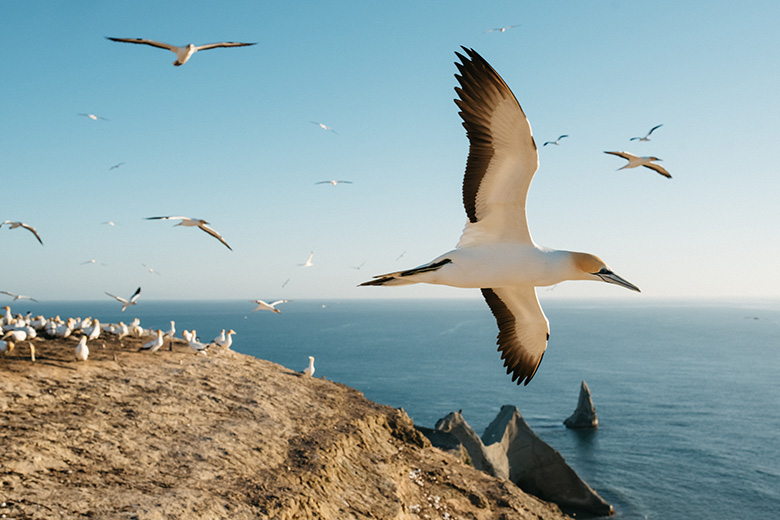
Everybody’s flocking back to Hawke’s Bay for summer. They’re here to recharge on a surfeit of long hot days, kaimoana and not much to do.
Some were born here – endemic to the area, you might say – a few are foreign. Many have had quite a journey to make it Down Under. No doubt they spend their stretch here wittering on about their travels, skiting about their long-haul trip, non-stop, how they shagged about in Alaska, but now they’ve landed all they want to do is chillax.
The godwits started it, arriving in October to a hero’s welcome. They’re like smarmy jetsetters who humble-brag on the socials with their tales of far-flung exotica and exhaustion. They don’t really do much, other than fly. They’re dull brown, a bit skinny, matchstick legs and a beak like a toothpick. Not like the royal spoonbill. Now there’s a bird worth watching!
Where I’m from, ornithology means knowing the difference between red-billed and black-backed gulls. Auckland has sparrows and pigeons (Latin binomial: Avius rodentia), and mushed up pukeko on the sides of roads.
Here in Hawke’s Bay, there’s so much to see for a birdwatcher we should all take it up as a hobby. Make it the regional pastime. Hold symposia. Invite the international clutch of birdwatchers to descend on Hawke’s Bay and birdwatch en masse.
There’s oodles of tourism opportunity too. From gannets at the Cape to kororā on the shoreline, we’re a guano-covered goldmine, a winged Who’s-Who. We’ve even got our own colony of 2021 Bird Of The Year (a questionable contender) pekapeka tou roa – long-tailed bats – in a farm shed in Waipawa.
In my garden I’ve got barbary doves, blackbirds, tūī, fantails and of course chickens. Backyard birdwatching is popular: nearly 8,000 people filled out the annual NZ Garden Bird Survey this year. Birds in general are popular: 52,000 people voted in this year’s Bird of the Year competition. That’s more people than voted for the TOP party in the last general election!
So, don your tilley hat, borrow Grandpa’s binoculars and set off across the motu. Pack a knapsack with sandwiches and a thermos, a Rite in the Rain waterproof notebook, a Blackwing pencil and the Collins Hand Guide to the Birds of New Zealand. Take a shooting stick so you can perch anywhere. You’ll spy stilts and plovers, terns, egrets and wrybills, shags, knots and oyster-catchers. Local bird legend, Bernie ‘Birdman’ Kelly, has a Hawke’s Bay list of 114 species, but the Hawke’s Bay ‘high score’ is 139. There are over 70 in the Ahuriri Estuary alone.
Birdwatching can be competitive, but it’s also contemplative. It’s a healthy mix between meditation and voyeurism, guaranteed to bring out the anchorite (or the stalker) in all of us.
Birdwatchers – or birders as they’re also called – are sometimes twitchers. (Every twitcher’s a birder but not all birders are twitchers). Twitchers treat birdwatching like a sport, ticking off as many species as possible, playing their own version of birdlife bingo.
Taking it to extremes is a Big Year, whereby twitchers aim to get as many birds as possible on their ‘list’ in a single year. The record is 6,852, which is over half of all bird species on Earth.
Birders are always looking for rarities, or birds who may’ve ended up here by accident. Keen eyes with good ‘bins’ won’t be looking at a flock of godwits; they’ll be looking within the flock for the outliers, those interlopers who have joined a flock and headed here without meaning to. In that way twitchers can add to their list without leaving the area.
There was great excitement among the Bay’s birders a few years ago when a Wilson’s phalarope showed up in the Estuary, because one hadn’t been seen in New Zealand before. The phalarope – “…unusual for their reversed sexual dimorphism and aberrant breeding systems…” – could be mistaken for a sandpiper and certainly got the birders all a twitter, racing to get it on their list before it flew off again. More recently, a Nankeen night heron turned up in Porangahau. There’s only a few of these in the country and they all live out the back of a cafe near Whanganui, so it was a real treat for the local twitchers to have one closer to home.
Start with Cornwall Park or Anderson Park if you’re looking for action close to our urban centres. Both have plenty of ducks, geese and swans, perfect gateway birds for juvenile twitchers keen to start out in the game. (Don’t feed them bread though. Despite children’s stories telling us otherwise, park fowl don’t do well on refined wheat).
Personally, I’m dotty over Dots: the banded dotterel who nest along the foreshore of beaches and rivers. They’re so camouflaged they’re impossible to see. Their eggs, the size and colour of pebbles, even more so. If you spot a dot it’s a big tick in your fledgling twitcher list! Be careful where you step if you go looking and keep dogs and quads well away, dot nests are fragile.
From Pekapeka wetlands to Waitangi Reserve to the mouth of the Tukituki, our feathered friends are everywhere. There’s lots of ways to get into birding including volunteering with local groups who look after habitats. Joining one of Forest & Bird’s three Hawke’s Bay branches. Or you could just begin by being a bit more curious during a morning walk along the river bank. From there it’ll take off and you’ll be a fully fledged bird nerd in no time.
Best tools for birders: Audubon.org is an excellent website for tips and tricks. Ebird is the must-have twitching app. Look out for Birdwatching in Hawke’s Bay by PW Twydle in second-hand bookshops, it’s a real treat.

Thanks Jess, great amusing comprehensive article. ‘BirdsNZ’ led by Bernie Kelly, is the best birding group to belong to locally – monthly field trips. Spring and Autumn ‘Meet the Godwits/kuaka’ events are held by Ahuriri Estuary Protection Society. ‘Save the Dotterels Hawke’s Bay’ is actively monitoring on the coastline every Spring till End of summer. (Two groups – Clive/Waipureku and Westshore/Bayview, who are also monitoring Awatoto/Marine Parade this year). They are also challenged by on-going beach fires and intermittent fireworks.
Very humorous ..
Australian Bittern ,, sounds like there is a local story with them also .. Like ,, well hidden and a bigger population in this country than Australia ?