

With councils’ rates on the rise, many ratepayers believe ‘bloated’ staffs are a primary cause.
In a recent BayBuzz magazine article (Fuses lit for 2025 bombshells, Nov 2024), we looked at the overall size of HB’s local government, noting that altogether it was a $1.2 billion enterprise, employing 1,665 people. Here’s the summary chart.
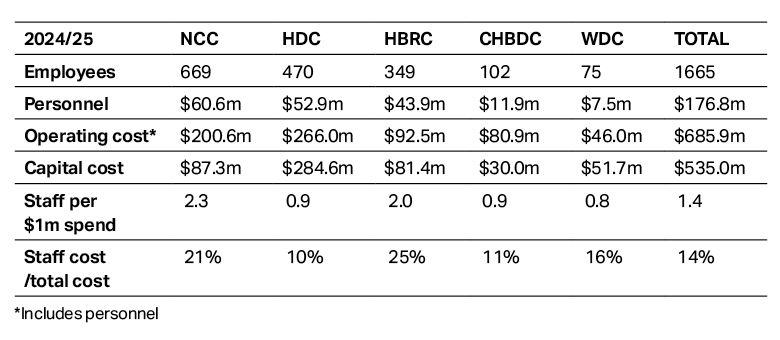
We noted that Napier City Council (NCC) seemed to be especially top-heavy in staff, and have looked more into that.
NCC argues that comparison across councils needs to take into account whether certain councils functions are handled by in-house personnel or outside contractors. In NCC’s case, significant numbers are employed directly by NCC to staff the council’s many visitor and public facilities. Here’s what that staffing looks like.
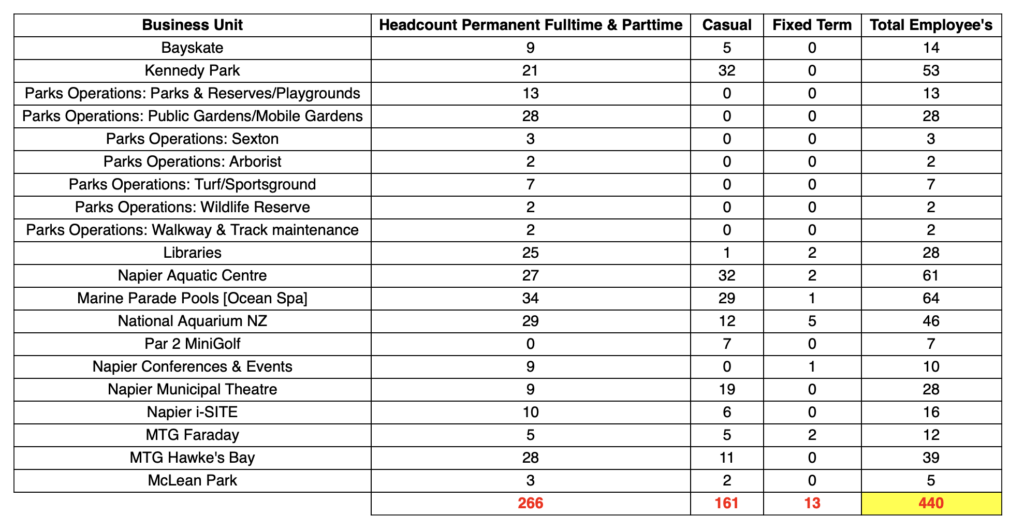
As emphasized in its current Annual Plan consultation, NCC is undertaking comprehensive review of many of these facilities to determine their future fate, including whether some should become commercial enterprises off the council’s budget and off ratepayers’ back. That’s something our Napier readers can have a say on until consultation closes on 30 April.
By comparison, here’s a chart showing how Hastings District Council handles its facilities staffing.
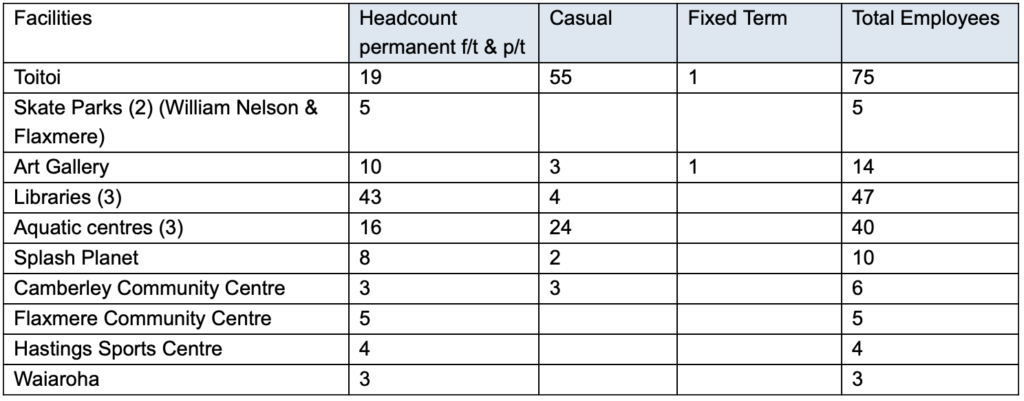
HDC’s total for similar activities is 209 employees. However, HDC does offload its ‘parks operations’ to private contractors. For NCC, ‘Park Operations’ account for 110 employees (including 53 at Kennedy Park). Subtract those from NCC’s total 440, and the Napier ‘facilities’ body count becomes 330 … still a hefty 121 more than HDC.
To which NCC would say: 1) our city’s visitor economy requires attractions; that said, 2) we are looking to commercialise some of these.
What’s your preference … should more of councils’ work around facilities be off-loaded? Either way, unless councils shed responsibility altogether in these areas (i.e. commercialise), ratepayers are still ultimately footing the bill.

This is what is happening – Council used to have dedicated staff and equipment needed to run the place. It was about the community and living within our means. Then, over time they have either sold off assets or made ratepayers pay more to maintain/use the assets or contracted those out and say that’s the problem.
The real problems are:
1) The majority of the current Council are focused on the wrong things and spend our $ unwisely.
2) The majority of our Council are not interested in the majority of the ratepayers opinion. Last annual plan hundreds of people came out against their 20%+ rise and they chopped it down a few % only, keeping all the things they wanted despite opposition. All consultation with ratepayers has followed this suit under Wise’s watch. Very rarely does she change her intended ‘preferred’ options as evidenced by several fails throughout her tenure. She is saying she has to make the tough decisions but she didn’t make those last year, so why believe her in an election year?
3) The majority of the current Council is influenced by entities that can stand on their own two feet and that we should not be giving $ and free Council time too. This seems to have increased since certain Councillors and ‘Executive’ staff members have been on board.
4) The majority of Council wants to increase housing, despite our infrastructure being at capacity and suggest we should decrease financial contributions from developers. They do not listen to the surrounding existing neighbours who oppose intensification. You need to fix what you have first before adding more things that will impact the things you already have. Simple stuff.
5) The majority of Council seem to generally not like their ratepayers. They see us as complainers instead of as the people they are meant to serve. Watch their meetings – on Facebook and YouTube. Read their reports. It’s all in there what the majority really think.
Here’s the solution:
Vote the ones who aren’t serving you out in October. Vote in people that care about their community, not lining their pockets or spending your $ unwisely. People have the power to change their local government.
We have the right to transparency and better management of our $.
We have the right to have our say, be heard, and be considered, not just be lumped in to a tick box to cover their hides.
Vote in October 2025.
Very well put together. It’s a FACT! We as Napier’s citizens get what we deserve! So be sure to register for voting, and cast your “Valuable Vote” on the peoples you sincerely believe in? The ones “claiming to best represent you! Who have a sincere and genuine empathy with the vast “community at large”.
Democracy and all that.
Ensure Your Vote Counts!
Aquarium has more staff than our libraries or parks staff. NCC ‘solution’ is to close one of our two libraries and spend $28m to build a new aquarium and subsidise that new aquarium with $2m in ratepayer money per annum. Close non-core facilities like the aquarium. Close the I-site and incorporate its functions into the library staffing and library. Sorted.
Napier has 171 staff for the pools and aquarium- of that 90 are full time/part time. I feel this is a ridiculous amount of people to employ. Surely these 3 places can be culled of some staff. I’d love to see the breakdown of how many hours per day these staff work. Maybe start laying off people at the top who do the rosters.
If our councils were run as private entities that were accountable completely to the ratepayers they would have all been sacked by now. They appear to thrive on photo opportunities and not hard work. If they had to work to a locked in budget and have to use their own money for shortfalls they would have to be more fiscally responsible or their pockets would be crying. All ratepayers should wait and see what harebrained scheme the government is going to come up with to make changes to local councils.
There is a glaring omission by [virtually all] local Councils. It’s an elephant in the room that Councillors seem unable to see. The omission, and it is evident in all cases, is that the Councils present NO analysis of their own operations. Are they economical and efficient? Are they overloaded with bureaucracy and red tape? Do they make timely decisions? Is the governance really effective? What about staffing levels? In brief, the issue is that the local authorities are NOT commercial businesses even though they might like to think they are. They do not have to solicit for customers or compete for marketshare. They do not have to price their services competitively. They do not have to pursue revenue actively. They rarely have to justify the level of their investment in local projects or to demonstrate that the project is value for money and is executed efficiently. Councils create, and “consult” on their future plans. But they can extract revenue for these projects, on DEMAND, from their “customers”. The customers have no choice other than to pay what is demanded. The customers cannot go elsewhere or refuse to “buy” the service offered.
Well said Brian.They never put their own ” household” up for review. That should be first action before asking customer to pay more. These are hard times for many people and for the counsel to expect the customer to pay up without leading the way by making cuts in their own “household” is bad management.
They should lead by example. Also we’re is the accountability from the high earners in the council for failing to manage the local infrastructure like water and pollution issues . These issues have been going on for many years without permanent solutions. More transparency and accountability!
Framing the regulatory, infrastructure, library, open space, cleaning, civil defence, transport and refuse functions of local authorities in a competitive business context isn’t appropriate.
Major operational level of service decisions are consulted on, as are most capital investments, and there is plenty of internal and central government oversight to monitor appropriate spending of public money and application of process.
Comments around the expenditure priorities of any Council is fully justified, and regular elections provide a level of accountability for the community to support a change or continuation of those priorities.
Do you think the community should be able to ‘opt out’ of paying rates? Or privatising functions to let the open market provide them? What alternative to the existing
(pretty much globally adopted) system would you propose that makes sure everyone has access to roads, parks & libraries at a fair and accessible level?
Not saying any individual Council is perfect, and there will always be efficiencies which could be made, but they’d actually be pretty minor in terms of the overall cost to deliver services.
I pay about the same annually in rates as I do electricity. For that I have access to roads, parks, libraries, drinking water, a wastewater system, stormwater systems, animal control services, regulatory services which make sure that a neighbour’s wall won’t fall on my house, that they can’t build a paint factory next door, that restaurants have decent sanitary practices. How much do you think they would all cost me commercially, remembering that someone would also need to be making a profit in the process?
In the context of ‘buying services’ I’m pretty happy paying my rates. Do I think every capital project is great and a priority for my dollars? Not at all, but I accept that I’m only one person in a community and that there are a range of needs and priorities across that community.
We are all feeling the cost of living increases, so a high rates increase after our power bills have skyrocketed, fuel companies are making record profits and groceries are costing an arm and a leg feels like an insulting kick when you’re already down, but I only see this level of vitriol (not aimed at your post specifically) against Councils, who also have to pay those bills.
There r too many as Hastings & Napier need to become part of the HERETAUGA plains as together the land can grow with the increasing traffic. Since the four lane highway is being built.. fantastic way forward please relise we r in this together
Yes to amalgamation and a rationalisation of management
Heretaunga city with Napier and Hastings suburbs. Build a rim city with the agriculture plains central and the residents living around the edge on the less productive areas such as korokipo ,taradale etc.
It doesn’t make sense to add up the number of employees working at each facility. Calculations should be based on the number of man hours worked, regardless of “part time, full time or casual”.
Thanks for your feedback, Bob. Yes, Council will need to pay those bills and yes, you are only one person in the community, as am I. However, the community has made their feelings known about a $58 million library, $5 million Waka Hub (including an additional amount of ‘better off’ funding provided as part of Cyclone Gabrielle) and $20 million ‘wetlands’ to treat our stormwater, and that is just the start of the $. The skeptic in me says that these will all be projected costs and will blow out. HB Tourism and Mana Ahuriri are two of the businesses we keep giving ratepayers $ too, and will continue to put their hands out because our current Council appears to be too scared to say no. It’s all there what they are spending and have spent our $ on. I, as one person, will be voting in October. I think I won’t be the only one.
And to think the Skate Club used to run Skatezone at zero cost to the ratepayer. Another great long term decision we have all inherited.
Comments in this story are very interesting https://baybuzz.co.nz/hb-airport-drops-bombshell-on-ahuriri-regional-park/
Gerry, comments are interesting. Thoughts comments are happening throughout Napier. Flights 24/7 over properties without consultation is a bit on the nose. I see Mr Flack, the new CE of Hawke’s Bay Airport Ltd (HBAL) contributed to a noise complaints standard/process at his previous post Christchurch Airport and other airports in NZ pay for mitigation to affected areas. Perhaps HBAL could follow suit? Seems like that is the least they could do? There is a Hearing Stream on this topic among others scheduled for 12-14 May 2025. Look forward to watching.