

[As published in November/December BayBuzz magazine.]
As you are reading this, our region’s five councils are pretty much winding down for the year on the policy-making front. I don’t foresee any major bombshells exploding. Although fuses are being lit, the explosions won’t occur until 2025, as this article will preview.
Which isn’t to say councils aren’t plenty busy.
Recovery works are in high gear, with councils awash in both rates-generated and government funding, particularly for roads and bridges (the Government has allocated $91 million for 2024/25), providing the region’s essential connectivity. Plus millions more for silt and other flood clean-up, including beleaguered Wairoa.
And with dozens of civil defence improvement recommendations in hand from multiple reviews, a great deal of work over seen by our Civil Defence Emergency Management Joint Committee is going into implementing those (benefitting of course more than weather disasters), while longer-term planning for flood protection proceeds.
Hawke’s Bay shareholder-owned Unison has committed $62 million to electricity infrastructure improvement over the same window. And millions more is being spent by the likes of Pan Pac, Ravensdown, Woolworks and other businesses severely damaged by Cyclone Gabrielle.
So there is plenty of physical activity buzzing away on the ground and carrying into the new year and beyond. If there’s a fly in the ‘rebuild ointment’ it might be in HB’s primary production sector, where many farmers and growers are still pushed to the wall by factors both local and global.
But back to councils.
A collection of critical issues needing policy attention – and then funding and implementation – are simmering beneath all that physical buzz and will come to a boil in 2025, which is a local election year to boot.
Rates and local gov’t affordability
The rate increases announced in recent long-term plans for 2025/26 were: CHBDC – 14.9%, HDC – 15%, NCC – 11.4%, WDC – 15.5%, and HBRC – 18.3%. In projecting those increases, councils were adamant that they would be reviewing their spending microscopically, both to actually achieve the savings promised for this year (2024/25) and to hopefully lessen the burden of the budgets they will adopt in June 2025.
This chart illustrates what our $1.22 billion HB local government ‘economy’ looks like:
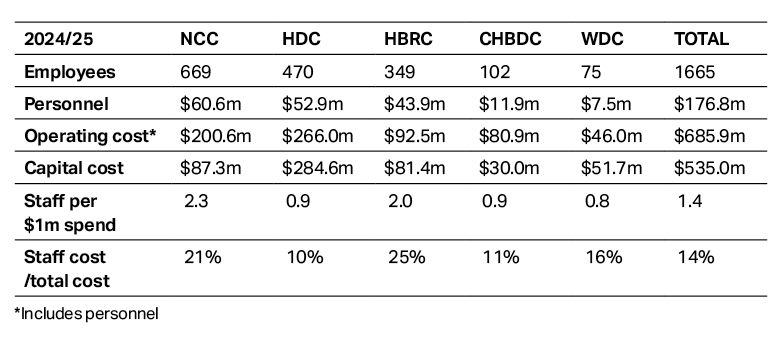
This is the time of year when councils’ planning for their June 2025 budgets has already begun, generally in workshops, some open, some not. Councillors tend to lose their zeal for open discussion when it’s time to talk ratepayer money. What they are planning for us won’t become clear until April/May.
There’s unlikely to be ‘Hail Mary’ funding in terms of significant new Crown support beyond what’s already flagged, so councils will be on their own as they set their numbers. With interest charges a key component of councils’ budgets, at least the down trend in interest rates might provide some relief.
That said, much expensive capital-intensive work lies ahead whose costs (beginning now) and long-term funding arrangements are yet to be decided – coastal protection in the face of climate change, flood resilience, and ‘3 Waters’ infrastructure.
A recent study by Local Government NZ on coastal protection across NZ put the cost of Hawke’s Bay’s endangered council assets from climate change at $1.2 billion (i.e., not including private and central government assets).
Early work (2016) done by Tonkin and Taylor for the Coastal Strategy group investigating how to address our coastal risks ‘cell by cell’ from Tangoio to Clifton gave high-level estimates between $130-$285 million for mitigating projects over the next 100 years. More recently, a high-level cost of nearly $2 billion has been projected for ‘planned retreat’ over the life of the strategy.
So finally, after ten years, a draft Coastal Hazards Strategy 2120 is in hand. We need to begin investing in our response, and councils are proposing a scheme wherein 70% of costs would be borne by affected property, 25% by HDC or NCC as relevant, and 5% allocated as ‘public good’ across the region.
This strategy and its funding plan will go to public consultation in roughly March 2025.
Meantime a recent Parliamentary Report of climate adaption (looking not only at coastal adaptation), receiving Treasury estimates that the recent weather-event damage to all NZ infrastructure is up to $14.5 billion, has effectively ducked the issue of potential government funding. The Report recommends that “investment in climate adaptation should be paid for by applying a combination of the following principles: beneficiary pays, exacerbator pays, public pays, and ability-to-pay.”
Then there’s flood protection.
Actually, what used to be called planning for ‘flood protection’ has been re-branded as ‘flood resilience’. This reflects the reality that no complete protection from the impacts of extreme weather events like Cyclone Gabrielle can realistically be provided.
Substantial technical work is underway to devise better resilience in the face of future flooding. This includes methods to channel and reduce storm flows, as well as to mitigate obstacles to flows (like bridges) and improve stopbanks.
But land/water management and engineering options aside, ultimately it is the entire community that will need to come to grips with its risk tolerance and where/how this risk should be spread as we seek to protect lives, neighbourhoods and maraes, ecosystems, businesses, private properties and public assets.
Our planners and engineers can and will no doubt come up with schemes that offer various levels of protection at various (inter-generational) costs. As with life or homeowners’ insurance, how much protection, how comprehensive, at what cost?
The community will need to make the call. And do so with the understanding that there will still be ‘design-exceeding events’.
A gnarly set of issues on which to seek public understanding, input and consensus. The HBRC leading this process reckons it will take most of 2025 to engage the community in a constructive manner. Regional councillors are grappling with how this might best be done, with clarity on the process hoped for in November … it would seem this won’t be just another ‘file your submission online’ exercise.
Meantime, there’s the now seemingly ‘old’ issue of how to provide NZ and Hawke’s Bay with first world water infrastructure – ‘3 Waters’ in the previous government, re-branded ‘Local Water Done Well’ by the current regime. In both cases, how to provide safe, reliable drinking water, manage storm water and provide effective wastewater treatment.
The Government has signaled clearly that it is expecting regional solutions to this challenge. And it is providing some balance sheet relief to local councils to increase their borrowing capacity (the Government has no interest in footing this bill). As BayBuzz has reported, our local leaders, at least our four mayors, have said they agree. After all, they pleaded for a HB regional approach during the Labour regime.
Figuring out the organisational and financial plan for how this water infrastructure could be provided was delegated to the HB Regional Recovery Agency, given its collaborative role and diplomatic skills. But the scutwork has been further delegated to staff at the Napier City Council.
NCC chief executive Louise Miller reports as follows: “From mid-October through to the end of the year we are focusing on making sure councillors across the region have a really good understanding of the options ahead of us … This includes looking at the financial impact of each model as well as viaibility and suitability.
“Before the end of the year, councils will make decisions about what model or models to consult the public on. In early 2025 – we’re currently looking at February – we will carry out public consultation. Final decisions will be made around the middle of 2025 to meet central government’s deadline for Water Service Delivery Plans of September 2025.”
Looking to spring to life also in 2025 is what would be HB’s biggest water infrastructure project of all, Ruataniwha Dam 2 … failed Ruataniwha Dam 1 in a new suit and far more expensive. Because a Supreme Court decision blocking flooding of conservation land put a final stake in the heart of Dam 1 back in July 2017, folks tend to forget that the dam was already falling over on financial grounds.
By that time, despite an intense two-year marketing effort, futures contracts had been signed for less than half the potential stored water, only 42.8 million cubes in contracts, signed by 196 farms from the eligible pool of 400-450. Not nearly enough potential revenue to generate an adequate rate of return against a dam costing $330 million at last estimate (exclusive of the distribution network and on-farm reticulation costing even more). These days, all of those costs together would easily make for a $1 billion plus white elephant.
However, Dam 2 has the distinction of being fast-tracked via the Government’s pending legislation. Proponents will need to apply officially for a green light when the window opens in late January/early February. This will be nigh automatic given the project will already be on the legislation-created list, but an expert panel will review and could impose fresh conditions. Assuming no unforeseen hiccups, a fresh business case will need to be prepared and marketing to potential water users and investors will proceed.
BayBuzz and others will have plenty of time to weigh in on Ruataniwha Dam 2 in the coming year.
Local body election & referenda
While planners and plotters are beavering away on all these issues in their quiet backrooms, our politicians will be focused on their 2025 election plans and prospects. Do you think that might affect their stands on any of the above?
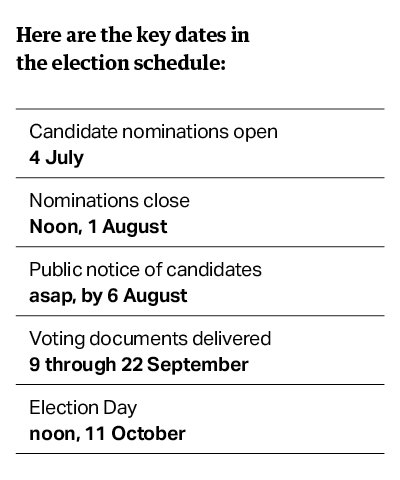
As you see, July will see the fascinating opening of political jockeying as incumbents ponder their resolve (fresh from their budget decisions) and challengers weigh their chances and plot their positions on the vexing issues described above.
Of course there will be one additional issue on our ballots – the question of Māori seats on the CHB, Hastings, Napier and Regional Councils. That contentious matter seems to have gone dormant for the time being. Expect it to come back to life as candidates declare in July. Any candidate with integrity should be expected to declare their position on this core governance question for our region.
Another issue BayBuzz will delve into in the new year.
So, council spending, cyclone recovery, flood resilience, coastal protection, water infrastructure, Dam 2, candidates, Māori seats … and we haven’t even mentioned where to build houses, how to fund tourism or [fill in your favourite].
Merry Christmas!

It’s going to be a hell of a year! I can hear all the claims and counter claims of candidates in the distance and coming closer over the coming months – not least will be the screams of outrage about Maori seats, and the support for them from most open minded NZrs.
Thanks Tom, for ‘keeping and eye’ on what’s (supposed) to be happening in HB. It will be a challenge for us ‘middle New Zealanders’ to keep track, let alone understand the flood of community consultations (eg tick box exercises?) that will come our way next year.