
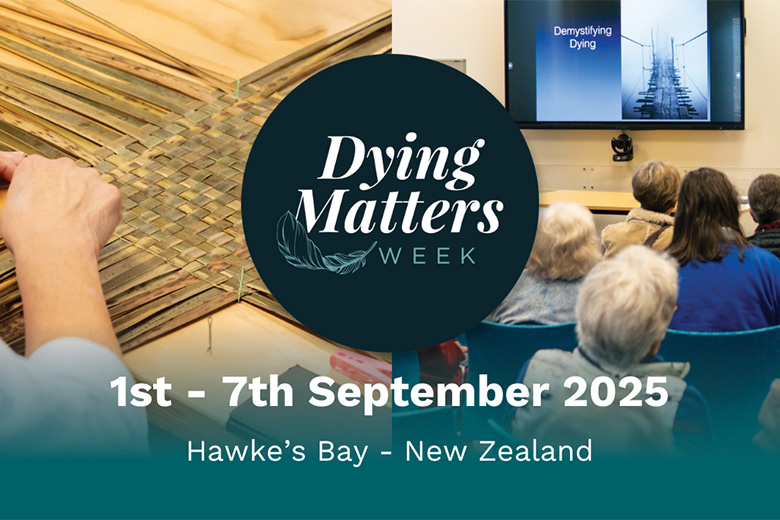
“No more deathly silences” is the rallying cry of a group of Hawke’s Bay women whose passion for changing the conversation (or rather lack of) around dying, death, and grief has seen them sign up to bring Dying Matters Week to our region in the first week of September.
Kicking off on 31st August with the first of three special performances of Tangihanga, the one woman show that’s the brainchild of Hawke’s Bay’s very own Kristyl Neho (Ngāpuhi and Ngāti Kahungunu), the week will then unfold with various information workshops and events, and opportunities to discuss all things death related in a supportive non-judgmental environment.
Based on similar initiatives that have been held annually in the UK for over a decade (Dying Matters Awareness Week in England and Demystifying Death Week in Scotland), it is a relatively new campaign in Aotearoa New Zealand initiated by Whangarei charity Go with Grace in 2024. The hope is that it will become an important annual grassroots event in our national calendar and increase the level of ‘death literacy’ in our communities.
The Hawke’s Bay week is spearheaded by end-of-life doula and funeral celebrant Alysha Macaulay. When she was asked by Go with Grace if she would instigate something here, she leapt at the chance saying “I passionately believe that engaging in open, healthy, and honest conversations about death, dying, and illness can profoundly empower us to live vibrant, fulfilling lives.”
Those working or volunteering in this sphere recognize that there is a distinct lack and avoidance of open conversations. As renowned palliative care consultant and author Dr Kathryn Mannix puts it “Death is a people thing, not a medical thing.”
A hundred years ago, death was certainly more visible and more commonly played out in the family or community domain. And while there have been remarkable advancements in medical care, ironically this may well have contributed to the ‘death denial’ attitude that seems prevalent across Western societies. Not facing up to the inevitable can lead to potentially unrealistic expectations of treatment, focusing on the physical to the detriment of the psychological, the financial and the spiritual.
Even those who are accepting of a terminal diagnosis may struggle to find people they can engage in meaningful conversation with, be that about their will, their funeral, their spiritual beliefs, their preferred place of death, their sadness etc. Often the bereaved feel a similar sense of isolation. The hope is that the Dying Matters Week can contribute to greater awareness and encourage and empower people to participate in those ‘hard’ conversations.
For many of those on the volunteer coordinating committee alongside Macaulay, it has been personal experience that has brought them to want to contribute to the wider discourse on death, dying, and grief and offer resources. Sue Haldane, from the Grief Room, will be talking in conjunction with the Acorn Project on several occasions across the week. “I have been committed for almost 20 years to creating room for people to speak openly and honestly, without censure or censorship, about their experience of grief. My focus is the loneliness (separate from being alone), the social isolation and, in particular, the silencing of it.”
For Kathryn Perks, it was her mother’s death that made her realise how much information is required for estate administration so she created the resource ‘When I Die’, an end of life workbook and planner that helps record information and end of life preferences. Kathryn will talk about her workbook at several points across the week including alongside a presentation from Cranford Hospice about Advance Care Planning.
This year the organising committee have opted to focus on events in Hastings only with the aim of broadening the outreach in 2026 and are grateful to the Hastings Library for coming onboard to host many of the sessions and discussions.
The week will include other presentations from Cranford staff covering topics such as ‘caring for the caregiver’ and ‘what does normal dying look like?’ And if you are interested in building your own coffin, the Hastings Coffin Club will be opening its doors to visitors. For those keen to know more about what the Assisted Dying application process looks like, Michael Nestmann, manager for the AD team within Te Whatu Ora will host sessions both at Acorn Project and the library.
Also confirmed is a screening of the US documentary “The Ecstatic Last Days’, in partnership with Focal Cinema Havelock North. Described as a ‘meditation on life and death’, the film follows the last weeks and the death of a young American man diagnosed with a brain tumour. A $10 admission fee will cover the screening rights.
To view the programme in full and book please go to Hawke’s Bay Events – Go With Grace.
The organising committee would like to leave you with this thought: A popular axiom used to be “Nothing can be said to be certain, except death and taxes” . These days it’s entirely possible for some to avoid taxes but thus far dying is still an absolute guarantee of life. So let’s face it and embrace it.
For any enquiries please contact [email protected] or message her on Facebook via Celebrant – Alysha Jayne.
Stephanie Hutchinson is a Cranford Hospice Counsellor
