


[As published in July/August BayBuzz magazine.]
If you’ve read our HB’s Top 50 Employers article in our July/August edition (you should), you probably noticed a pattern – 60% of them are in the food business, either as direct producers or as businesses that exist mainly to service food producers.
They are the bulwark of the region’s agribusiness sector, which in turn is the bulwark of the region’s entire economy when one takes into account all the other legal, accounting, HR, comms and other service providers for whom HB’s agribusinesses represent a major chunk of their income. Plus the trickle down as all these folks buy cars, electric bikes, coffees, pay rents and rates.
That’s our present economic reality. But what about the future?
We’ve seen that one cyclone can have a billion dollar impact just on that sector alone.
Climate change with severe weather promises future disruption to the primary sector, but so too does a lengthening list of other disruptors – rising sustainability expectations of overseas consumers (our food sector’s lifeline), transport costs and other supply chain issues, generational ageing within the farmer community, limits on the extent of additional versatile soils (if not actual loss, see Mark Sweet’s Baybuzz article, Not all soils are created equal), and more profitable non-food uses of land (from forestry to solar farms).
To say nothing of wars and pestilence, which, granted, would affect most if not all sectors and economies.
As a region, most of our economic growth eggs and aspirations are in this one basket. Is that healthy? Or a prescription for increasing regional economic vulnerability or stagnation?
How much more meat, wool, squash, onions and apples can we squeeze out of finite Hawke’s Bay? For how long? And is that our region’s best path forward?
Any decent investment adviser would say too much concentration of one’s assets in one category is dangerous. Diversify, they would say. Shouldn’t that apply as much to the region’s ‘portfolio’ as it does to our personal ones?
Yet in the face of that prudence, the last iteration of our Regional Economic Development Agency (REDA) issued a report identifying six industries that would drive and “underpin the region’s economic development”. Five of those were forestry and wood processing, horticulture and associated processing, meat and meat processing, food and beverage product manufacturing, and machinery and equipment manufacturing (which in HB relates significantly to food production and processing). They threw in another for good measure – wool and textile manufacturing.
Double down on agribiz, said REDA. Huh?!
Including wool, these industries were estimated to add 2,131 jobs in Hawke’s Bay over five years (2024-29). Within that fasten-your-seatbelts number, most notably 1,800 jobs were to come from horticulture, whereas meat would lose 85.
Peak meat?
Let’s look at meat, which accounts for 36% (the largest chunk) or $1.2 billion of HB’s export value in 2023.
These days, the meat industry (and the Government) boasts of record NZ meat (and wool) export sales – up 8% to $12.3 billion in the year ending June 2025. Here’s where all our food exports go. Our meat and wool heads predominantly (52%) to the US and China.

But these reports always emphasise export revenue. And our meat exports are currently enjoying very favourable pricing and currency conditions. So we’re generating exceptionally high revenue off the volume we are producing.
What gets less headline attention is the actual production levels that earn the revenue. And for our meat and wool exporters, the production future is not so rosy. As this chart indicates, beef cattle volumes are predicted to be flat over the next five years, while the country’s sheep flock is in steady decline.
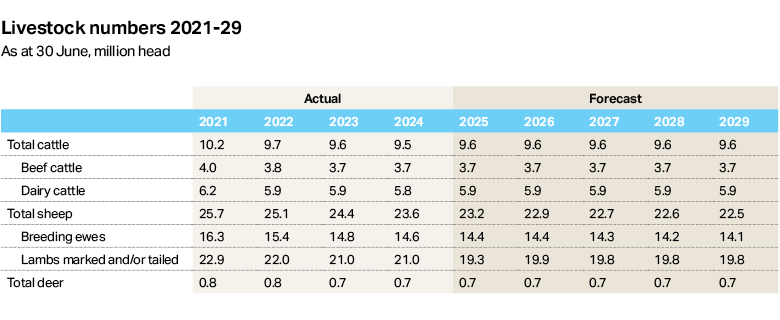
No one is suggesting these stock trends will reverse. It’s tough to see how flat or lower volumes can sustain the high revenues currently enjoyed. Throughout NZ, meat processors are contracting – our own Silver Fern Farms has had two years of losses; AFFCO is said to be struggling. And ASB reports: “The expected average profitability across all classes of sheep and beef farms is forecast at $45,300 for 2024/25.” Not good news for a key inter-generational issue – farm succession. No wonder job losses are predicted for HB … only 85?!
Forest harvest volumes are also flat. Only horticulture is predicted to grow, with apples leading the way, happily for Hawke’s Bay, but even there volume growth is predicted to be modest and only 300 more hectares are expected to be planted by 2029.
Our apple industry in particular has prided itself on innovation and per-hectare productivity. Indeed our apple breeders, juice and cider makers are trying to extract more value from our harvests. But there will be a physical limit to the value that can be extracted.
Meantime, in Hawke’s Bay, we don’t make wine, raise beef cattle and sheep, milk our few dairy cows, grow apples and squash, or harvest pine trees to meet the food and fibre needs of our region, or even the wider population of New Zealand. We produce virtually all of this stuff for overseas consumers.
So let’s get real, they and their governments are our masters when it comes to both the price paid for our production and, equally importantly, the acceptable conditions in which that production occurs. By that I mean standards and expectations on everything from chemical residues to animal welfare to labour treatment to environmental footprints. And those expectations are only getting tougher.Heard enough? As important as it now is, does HB’s primary sector sound like a growth opportunity to you?
When do we decide to pursue economic diversification? How do we suppose that might occur? Do our councils or a new Regional Economic Development Agency have a role to play in stimulating other discussions or opportunities?
These are questions I’d like to hear our local candidates address – either to suggest specific ways to prime the diversification pump, or to concede they see local government is a mere bystander.
