

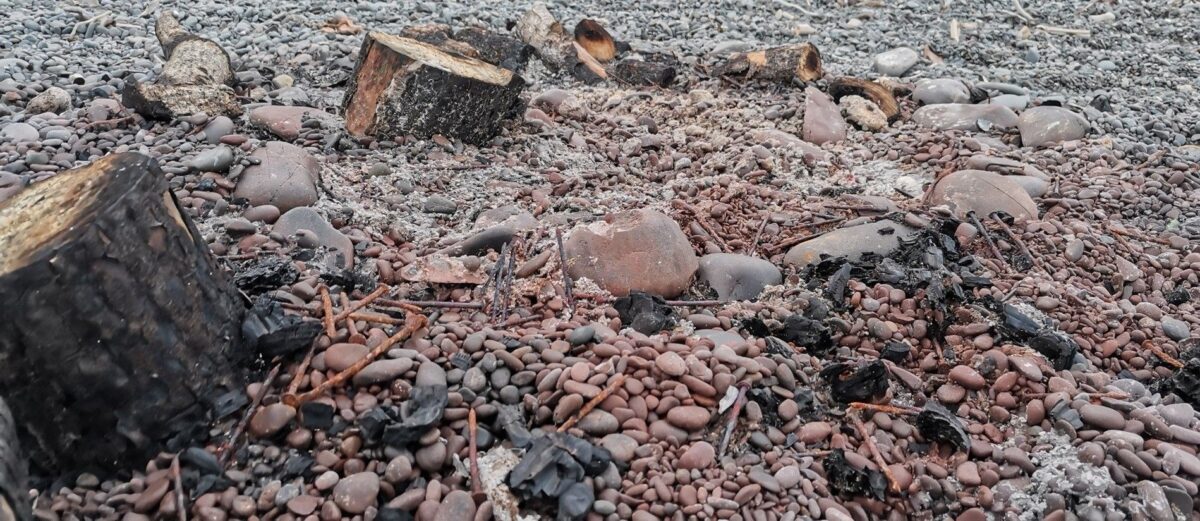
A cluster of environmental groups says Napier’s beaches are being treated like “wasteland” and need a fire ban bylaw to be reinstated.
The bylaw that banned fires year-round on Napier beaches was revoked by the city’s council in December 2024.
Lynne Anderson is now asking for it to be reinstated to prevent people from lighting fires on the beach whenever and wherever they like.
She presented her case to the council’s delivery and regulatory performance committee meeting last week on behalf of the Napier Branch of Forest and Bird (who requested the forum), Biodiversity Hawke’s Bay, Save the Dotterels Hawke’s Bay, Ahuriri Estuary Protection Society and Birds NZ.
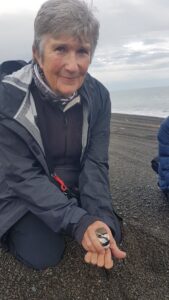
Anderson, who is the region’s co-ordinator for Save the Dotterels, said the groups was “hugely concerned” about the lack of fire control on Napier’s beaches.
“Volunteers walk the beach three or four times a week. We know what goes on there, we are asking you to please reinstate the fire control bylaw or at least during nesting season.”
She also urged the council to consider designating beach areas for enhanced protection and restoration.
News of the bylaw’s revocation came to light in July 2025 after Local Democracy Reporting sought clarity on the legality of Matariki fires.
At the time, the council said it revoked the fire ban, part of its 2021 Parks and Reserves bylaw, following a vote by councillors in 2024, because it “contradicted” the Fire and Emergency NZ Act of 2017, which took precedence.
At the time, the Hawke’s Bay Regional Council, which is responsible not just for the management of the beach from the high water mark to the sea, but also air quality in the region, said it had no problem with fires on the beaches as long as they were done with natural materials.
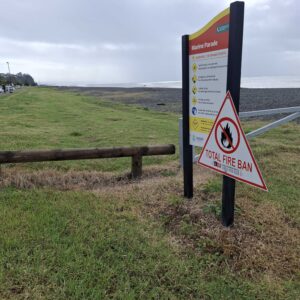
Despite that, a ‘total fire ban’ sign still remains on the beach right next to the National Aquarium of NZ.
Anderson said the information she had from Fire and Emergency was that if a local council owned or had jurisdiction over the land, it was entitled to have a fire bylaw, including all-year fire bans.
“In Hawke’s Bay, we have shingle beaches, which are valuable ecosystems providing habitat for many different species. But sadly, in Napier our beaches seem to be treated like wastelands.”
She said driftwood was an important component of the beach habitat, providing shelter, harbouring invertebrates and creating camouflage. But here driftwood seems to have become the enemy, and the more to be burnt the better. Now, south of the aquarium, there’s not a sizable piece of driftwood in sight.”
In 2023, Ngāti Kahungunu introduced a hugely popular Matariki Mahuika Beach Fire event and invited people to head to beaches and light a fire using the driftwood left on the shore by Cyclone Gabrielle. Hundreds of people turned up, lighting fires along the coast.
The removal of the bylaw paved the way for the event to continue annually without concerns about legality.
Anderson said when she heard Matariki was to be a national public holiday, she was excited, but now felt sad when she thought about it. “I know it was organised with the best intentions to bring people together to share goodwill through fire, but it’s also meant to be about cherishing our environment.
“People now think that is what Matariki is all about – go to the beach and light a fire. I don’t think the organisers realised that the event would be so damaging to our beaches. If it keeps going year after year, there won’t be any wildlife left.”
Ngāti Kahungunu event organiser Te Rangi Huata said the Marine Parade fires were something he was proud to be a part of.
“We see the beach as a taonga. Last year, volunteers carried out a clean-up the next day, collecting around 100kgs of rubbish, most of which had been there beforehand,” Huata said. That spirit of care is at the heart of what we do and is one of the values that Matariki brings to our public places – education, shared responsibility and looking after our environment together.”
Mana Ahuriri general manager Parris Greening said they supported their iwi in the celebrations held on the beachfront. “We are also mindful of the effects that people have on our taiao. Our voluntary contribution to cleaning the beach up after these events found that most of the participants took their rubbish away and entered into the spirit of the event.”
He said fire was an integral part of the celebration, and it was done in a respectful and low-to-no-impact way.
Anderson said during her presentation that other local councils had fire control in their bylaws.
“It appears the Napier council has no authority to control fires on its beaches. I’m asking you to consider what our beaches might look like in the future, 10, 20, 50 years. The future damage to beach ecosystems may be irreversible and become the new normal. We could be at a crossroads now and something needs to happen,” she concluded.
Councillor Keith Price congratulated Anderson on her presentation and said council staff would explore opportunities and get back to her.
He later told Local Democracy Reporting the next steps would be for staff to liaise with authorities. “If we can help, we will. It’s a good thing to have great people doing good things in our community. As the chair of the committee, I will be watching progress, however staff have a lot on their plates at the moment, so I’m not sure how long it will take.”
Anderson said she loved the natural environment and that “it breaks my heart to see what is happening to it. It’s so special. But we have lost nests to fires, vehicles, don’t even start me on cats and human interference.
“Guy Fawkes is always a nightmare – right in the middle of nesting season, we always lose nests at Guy Fawkes. There are no controls in place – people just go wherever they like, with their crackers and alcohol and light a fire.”
LDR is local body journalism co-funded by RNZ and NZ On Air.


As usual environmental issues are at the bottom of everybody’s concern lists. Let the destruction continue!
Accompanying a beach wasteland is a desert of green grass, regularly mown to a past, out of date, environmentally destructive perfection standard of low growth height. This is accompanied by a traffic 100km allowed speed limit past the three very narrow entrances to beach access areas south of the Pump Track.
We support Lynne’s korero.
It is not my experience that the rubbish ‘was there before Matariki’, and ‘people take their rubbish home’. A number of us have spent time over weeks dealing to many fire-beds to remove nails, wire, and glass. A one-off clean-up the next day after Matariki fires (of which there were approx 150 fires from Awatoto to The Port) hardly scratched the surface of the fire-beds. And many were still smouldering. Some required digging through for 10mins+ to loosen the gravel and release the nails/wire which were then collected with a large magnet. Guy Fawkes was the same. We certainly haven’t attended to them all over the months.
Our groups have gone to ‘beach fire’ meetings with councils, DOC and sometimes the fire organisers for a couple of years now to try to find a solution to the damage to the foreshore. Until there is willingness for compromise for the sake of the environment, the ‘pink’ dead fire beds along the foreshore, bereft of life, will become the norm.
Angie Denby
Ahuriri Estuary Protection Society
Totally agree Angie. Those who light fires need to understand that the damage is done, by the fire, while it is burning. Wildlife does not survive having a fire over its home or nest and clearing up the next day, while welcome does not repair that damage.
Lindsay Bates Save the Dotterels