

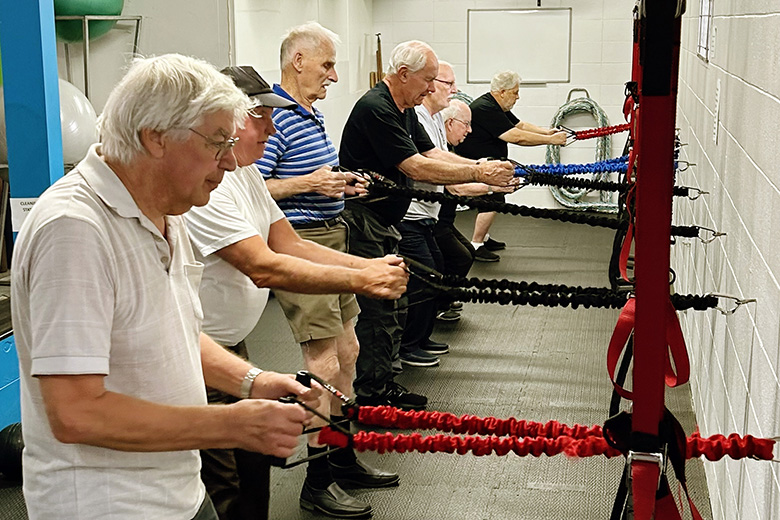
Virtually every week I see some alarming reference to projected population growth for Hawke’s Bay.
Typically, this vaunted population growth is used to dramatise the need for infrastructure growth in the region – more housing, more energy and, of course, more water (i.e., dams).
This anticipated growth seems mythical in scale. It is not happening. And there’s no reason to believe that it will change without unprecedented migration into our region.
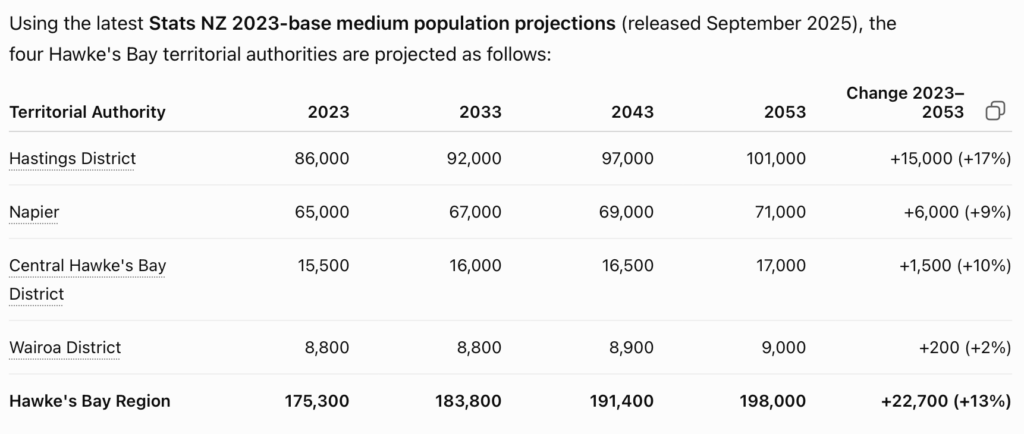
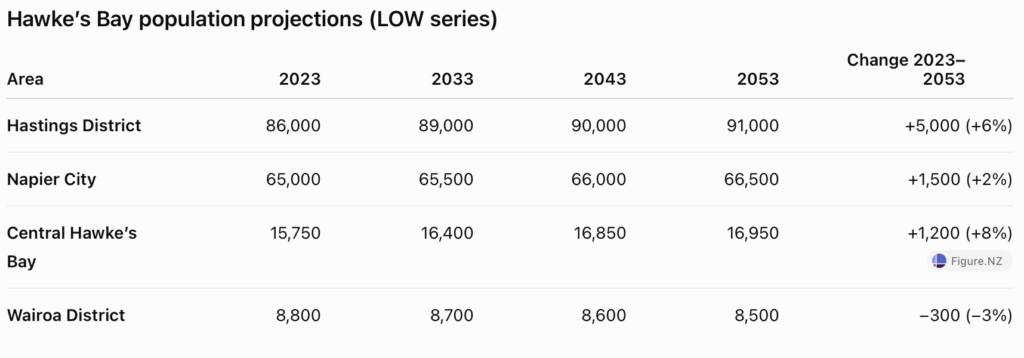
Compare the follow two charts.
First is the most recent ‘mid-range’ projections from StatsNZ, showing 13% growth over 30 years, or about 757 per year. Hardly a tsunami.
The second is the low-range’ projection, showing only 4% growth over 30 years, or 257 per year … basically a small subdivision (or moderate senior centre) per year!
Which of these is more believable?
At a more granular and recent level, here are the ‘growth’ numbers for Hawke’s Bay for 2025 over 2024, from Stats NZ as sorted by Infometrics:
| 2024 | 2025 | Growth | |
| Napier | 66,500 | 66,400 | -100 |
| Hastings | 88,300 | 88,300 | 0 |
| CHB | 15,900 | 15,950 | +50 |
| Wairoa | 8,950 | 8,940 | -10 |
| Total | 179,650 | 179,590 | -60 |
Infometrics summarises the situation for NZ: “Looking ahead to 2026 and beyond, we expect more of the same. With a muted labour market, there’s little impetus to bring in workers from overseas, so we expect international net migration to muddle along at its current low levels. Natural increase will continue to deteriorate as the population ages.”
Meantime, a prestgious NZ think tank (Centre for Informed Futures), led by Sir Peter Gluckman, a former chief science advisor to prime ministers, has recently issued an in-depth report on NZ’s population situation, with the principal expert involved being demographer Paul Spoonley. He wrote this BayBuzz article in May 2025, Will HB’s population continue to grow?
The report is titled People, place and prosperity: The case for a population strategy. This paragraph summarises the situation:
“New Zealand’s demographic future will be defined by slowing population growth, driven in the first instance by declining fertility and a growing reliance on immigration as the major, if not only, source of population growth. Slowing population growth will be reinforced by the rapid ageing of the New Zealand population. Within several decades, a quarter of all New Zealanders will be 65 or older, a situation unheard of in our history. Many regions will exceed the threshold for hyperageing, with over-65s making up more than 30% of their respective populations. [Editor: HB will be one of those.]
“Our rapidly changing demography carries risks and opportunities that will shape our ability to realise the overall goal of a prosperous future. Labour shortages and skill gaps brought about by falling fertility, the exit of an older population from the workforce, and growing global competition for workers and talent threaten our already falling productivity. An ageing population, along with changing dependency ratios (the ratio of non-working age dependents to working age population), place additional pressure on public finances as an increased need for public services runs up against a shrinking workforce. Growing ethnic diversity presents unique opportunities for innovation, creativity and problem-solving. But, as we have seen elsewhere, it also represents a point of fracture and division if underlying anxieties are not addressed.”
Are we ready for any of this … NZ-wide or in Hawke’s Bay? No.
Here in HB, we blithely predict continual population growth, feeding the ‘case’ for more houses, wider roads and dams. Commenting on HB planning, Spoonley observed in his BayBuzz article: “Like many local authorities and development agencies throughout New Zealand, there is a tendency to assume a level of population growth that is unlikely to occur.”
The Gluckman Report observes: “New Zealand’s rural areas are shrinking, posing a unique set of policy considerations for decision-makers. Rural areas have continuously experienced low growth rates, even experiencing periods of population decline between 2001 and 2013, and again since COVID. Concerns are rising that rural regions are hollowing out as younger adults migrate away, leaving an ageing population with limited internal and international migration to offset population decline. Policy makers must subsequently consider how to service smaller communities and support rural businesses.”
For NZ as a whole, the key dynamic is fewer workers to support an expanding, ‘unproductive’ and unhealthy, but longer-living age 65+ segment.
After predicting slower population growth, the Report observes: “If New Zealand cannot rely on population growth to offset fiscal pressures, policymakers may need to consider revenue reforms to ensure financial stability and sustainability in the long term.” It’s not just a national issue affecting the affordability of Superannuation and healthcare.
Here at the local level, we are increasingly aware that our aging population is the segment least able to absorb continual rates increases.
The Report makes an irrefutable case for developing a national population strategy to deal with these known trends. And comments with respect to regions:
“A population strategy for New Zealand must include a national spatial plan which considers where future population growth or decline is desirable and connects this with immigration settings, workforce and infrastructure planning. A population strategy must also leverage data and evidence to anticipate future community needs. Responses must be tailored towards metro, provincial and rural areas, noting their different needs (for example supporting rural development and connectivity planning).”
In short, we need major and better informed planning based upon more realistic population numbers.
You can download the Gluckman/Spoonley report here.

From a lifestyle viewpoint the less people, traffic etc the better – much more peaceful and no rush especially for us oldies! From an economic viewpoint the outlook is somewhat depressing – less people, less spending, less everything. The rush to the major cities continues and HB becomes more isolated – we’re pretty much cut off from the main artery of travel in NZ and are overlooked. But rural NZ is declining as evidenced by the lack of any care by Parliament who seem to have eyes for the major cities only. That’s likely to continue since that’s where the seats of power are won or lost – so rural districts become less and less important.
Hastings district has the prison > population will always be growing