


Outdoor burning is banned from 1 May until 31 August for all properties in the Napier and Hastings airsheds. But this doesn’t satisfy everyone.
HB Regional Council says the seasonal ban is in place to protect Hawke’s Bay’s air quality, especially during colder weather when smoke can become trapped close to the ground.
“We all share the air around us, and to put it simply, we breathe what you burn. Smoke from backyard fires may not seem like a big deal, but it builds up across our region on cold, still days and lingers in our neighbourhoods. These rules help protect our whānau, especially tamariki, from the harmful effects of smoke during the colder months,” says HBRC Group Manager Policy & Regulation Katrina Brunton.
Outdoor fires are allowed outside of the airshed, provided certain rules are followed. These include only burning untreated wood, paper, cardboard, or vegetation, and ensuring that the fire isn’t impacting neighbouring properties.
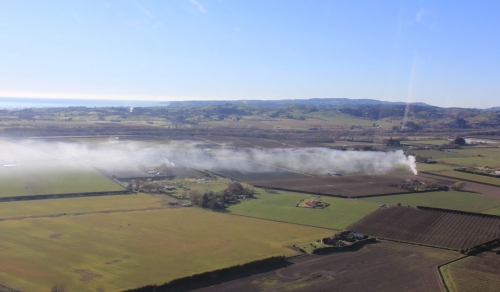
Former HBRC Chairman Rex Graham calls the ban “absolute bullshit”. He adds: “Smoke doesn’t abide by lines in the sky, it just goes where the wind takes it. Often you’ll see the Heretaunga Plains covered by smoke from multiple fires. This so-called ban is really a license to pollute. Orchardists doing these burnings amounts to vandalism, because they have alternatives.” In Graham’s view, no orchard burning should be permitted, ever.
Most EU member states have banned agricultural waste burning, including orchard residues.
Meantime, HBRC (and Graham) says residents can still enjoy barbecues or hāngī fires. “Please consider your neighbours before you light fires. We encourage everyone to check the forecast and burn responsibly to prevent nuisance smoke,” adds Ms Brunton.
People should check with Fire and Emergency New Zealand (FENZ) before lighting any fires and contact their city or district councils for bylaw rules related to open air fires.
Anyone wanting to report nuisance, or illegal burning can contact the Regional Council’s 24/7 Pollution Hotline on 0800 108 838.
To check whether your property is within an airshed, or for full details on outdoor burning rules, visit hbrc.govt.nz, search #burning.

Isn’t there a machine(s) that can take large branches and so on and grind it up to a mulch – it was proposed for forestry slash at one stage – surely orchardists could use such a system – and the mulch could be used for many purposes around the Bay so there would be no need for burn offs.
There is a lot of unintelligent burning going on but some burning is necessary at present. Gabrielle flooded many orchards & many fungal diseases are rampant at present. The worst is European Canker, which sporalates year round. We removed 300 apples bins worth of infected wood from just one block. There is currently no way to deal with this waste except burning as mulching doesn’t kill it. The same is true for brown rot in stonefruit. We use a mulcher sometimes but it chews through diesel like you wouldn’t believe, so far from a perfect solution. I agree it’s a problem but so far we can’t see the obvious solution.
Hi Paul, The worst of the damage from Gabrielle was mulched, thanks to minister Parker. I agree canker is a challenge but it can be mulched and sent to biogro to be processed.
Growers burn because it is cheaper than the alternatives and because they are legally permitted to pollute our air. This morning Hastings and Havelock were covered in smoke from two large fires lite during the frost whilst the inversion layer was active. The small particles in this smoke are cascinogenic and especially dangerous to our young people and the elderly.
Sure mulchers use diesel but that’s much smaller damage to our environment against the alternative dangerous air pollution and carbon release.
A smoke-free Hawke’s Bay, now there’s a populist notion. Rex’s legacy really is the acceptance of non confineable sprays, sprays that disperse similar to smoke. Hort research, crop and food have never ever done any substantive studies into the health effects of the toxic products used by orchardists and off site drift. The derivatives of lime sulfur; hydrogen sulfide (an oxygen scavenger, a mitochondrial poison) sulfur dioxide ( a respiratory irritant) and sulfurous acid (corrosive of eyes and throat) have visible health effects. Councils have enabled Numerous schools to become surrounded by orchards, the toxic product enshrouding our most vulnerable. The Regional Council and Area Health Board have never supported doing research into these matters. The stats kept by the Health Board are abysmal and as such meaningless, as are 0.3 micron air quality monitors (measure smoke alone). A grandparent’s day at one school indicated at cursory glance some 75% having had strokes. A rather high and arguably unneccessary attrition rate. If you want feedback on the carcinogenic impact, talk to the local hospice, or you may find an honest orchardist, someone with cancer themselves and also amid their immediate families somewhere perhaps amid the largely cavalier narcissistic bunch. In the past I have presented ‘reversal design’ stats to both the Regional Council and Health Board showing the health effects of such sprays albeit to no avail. The unfettered perpetuation of a toxic industry is far more important to the Hawke’s Bay. As if existing exposure is insufficient, some orchardists are even providing day care facilities on their orchards for employees’ children, such is their concern, which is lauded by Council and industry leaders as innovative.
Relative to the harm done by the more toxic products used on orchards, smoke is of considerably lesser impact. As of interest, lung cancers cluster around the main road, probably something to do with diesel fumes methinks.
for those of you obviously suffering from brain fog as an artefact of hydrogen sulfide and other toxic combinations, methyline blue (the chemical indicator) is very effective at enabling a clearer vision.
A smoke-free Hawke’s Bay, how can you go wrong?
Hi Morton, Not sure my legacy is the acceptance of spray drift, every one who know me knows that I have been proactive in this area for over 45 many years. I agree we have some very permissive rules in regard agri chemicals in NZ, permitting the use of some really dreadful materials which are banned in most other country in the world. I do however think that most growers are concious about their responsiblity in the use of agri chemicals but there are always the cowboys, just as there are with fires.