


Banded dotterels nest quite widely on our beaches, but are not doing well.
According to Lynne Anderson of Save the Dotterels HB, “The birds have evolved to defend themselves against aerial predators (hawks, NZ falcon, gulls) – hence they are very well camouflaged – as are their nests, eggs and chicks. They nest directly on the stones of the beach in a ‘scrape’ nest.
“They now have to not only cope with introduced predators – cats (often domestic), rats, mustelids, hedgehogs – but also a lot of disturbance on the beaches from people, dogs, vehicles. And the constant fires on beaches have certainly taken a toll on nests.”
There are two groups of volunteers in Hawke’s Bay – one at Waipureku/Clive (coordinated by Marilyn Scott) and the Ahuriri/Napier group (coordinated by Lynne). Sites are monitored over one and half km at the Bayview/Westshore site, a few nests near the Westshore surf club, and this season, Marine Parade and the full length of Awatoto Beach down to the buildings opposite Ravensdown.
Lynne reports, “From about 26 nests just (say for about 1km) south of the Aquarium – not one has hatched – all predated or disturbed. However the nests down the other end of the beach have done a lot better.”
Recently a international/DOC team of bird banders visited Hawke’s Bay and banded 21 of our birds. Luke Eberhart-Hertel, who leads this study, works for the Max Planck Institute in Germany. Birds were banded in the South Island, where they also fitted transmitters to the birds to track their migration. Hawke’s Bay is the first North Island location in this 5-10 year study.
In these photos, taken by Luke, the green-white combination on the bird’s left leg is for Hawke’s Bay; each bird can be individually recognized by the colour bands on their legs. Birds were banded in Bayview/Westshore sites, Waipureku/Clive and Awatoto, with more to be done by a DOC team.
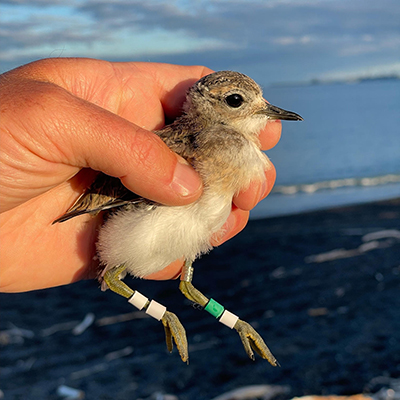
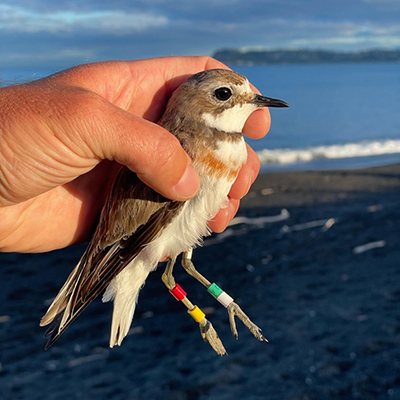
BayBuzz received a report on the project from Eberhart-Hertel, courtesy of Lynne Anderson.
“Pohowera (banded dotterel, Charadrius bicinctus) are listed as ‘Nationally Vulnerable’ and are declining at an unsustainable rate of 3.7% per year. Pohowera exhibit a unique migratory behaviour unrivalled anywhere else on the planet, whereby individuals do remarkably different things: some stay on their Aotearoa nesting grounds year-round, others migrate to other coastal areas within Aotearoa whereas others fly across the Tasman Sea to spend the winter in Australia.
“Introduced predators, habitat loss and human disturbance are key threats known to endanger the survival of the dotterels on the breeding grounds, however the threats that pohowera face at their nonbreeding sites and along their flyways are poorly understood.
“We are researchers specialized in studying bird migration from the Department of Ornithology at the Max Planck Institute in Seewiesen, Germany, and have formed a collaboration with the Fauna Science Team at DOC to solve some of the conservation problems facing pohowera.
“The purpose of this study is to: 1) identify the migratory movements of pohowera so that we can determine which threats need to be managed at nonbreeding sites and along their ‘flyways’ (i.e., migratory routes connecting seasonal sites), 2) understand the origin story behind the unique migratory behaviour of pohowera in the context of Aotearoa’s ancient history. Pohowera are found across a wide range of habitats, linking ecosystems from the far south to the far north of New Zealand. The information we gain will be directly applicable to the conservation concerns of pohowera and other mobile native wildlife of Aotearoa, including how they use the Public Conservation Land network throughout their annual cycle, and how adaptable they will be to climate change.
“In October and November 2024, our team visited nesting sites of dotterels around New Zealand and the Chatham Islands. We searched for nests and captured adults either with a self-triggered clap trap on the nest or with mist nets off the nest – both safe and well-established methods for capturing dotterels and other shorebirds.
“After capture, we banded the adults with a unique combination of leg bands or a white engraved leg flag so anyone can identify individuals in the field. We also collected a tiny blood sample to understand how genetically distinct breeding populations are throughout the species’ range and if the migratory strategy of an individual is genetic. Three breast feathers and one flight feather were also collected to determine an individual’s stable isotope signature, from this we hope to determine if a bird was migratory or not based on chemical composition of the feather.
“Our handling usually took < 15 minutes per bird. We also took standardized photos of all birds and nests. We deployed satellite tags on adults caught in four locations on the South Island and two tags were deployed on the Chatham Islands. During the winter, we will use the satellite tracking data to locate these birds and conduct behavioural observations. We are at the early stages of our project, but we will set up an email depository in the next month or so where the public can report re-sightings of the flagged or colour banded birds and explore the banding data themselves. These data will be submitted to DOC’s FALCON system biannually.”
Here’s more information on the local efforts to protect this ‘Nationally Vulnerable’ species.
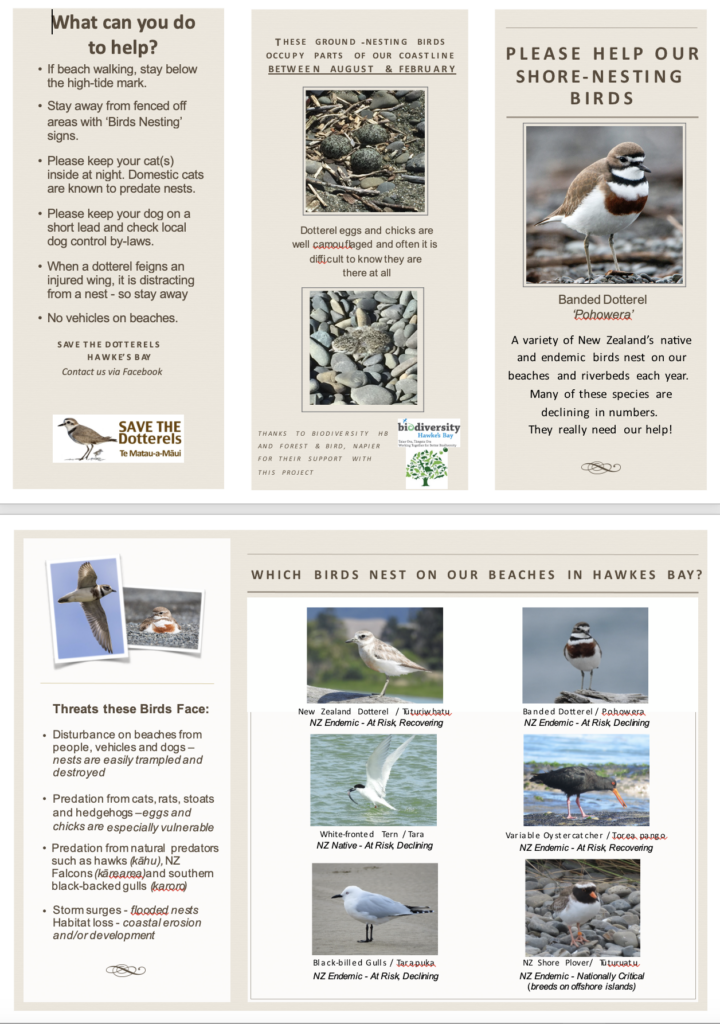
And here’s an excellent, well-illustrated report prepared by Marilyn Scott from Save the Dotterels – Waipūreku describing the work they’re doing, which is supported by the Pan Pac Environmental Trust. A fascinating read.

I am keen to know if banded dotterils are nesting at Ocean or Waimarama beaches where we like to let our dogs run about. Have studies been conducted anywhere other than the shingle beaches mentioned?
There are NZ dotterels (Tūturiwhatu) nesting at the far end of Ocean Beach – Cape Sanctuary end! These Dotterels, also endemic to Aotearoa, are also endangered and are rarer in HB than the Pohowera (banded dotterels) that prefer the stoney beaches. HBRC have some excellent survey reports published on their website, conducted by ornithologist Niki McArthur, that show where both types of Dotterels nest right around the HB Coastline.
I’d also like to add that if a bird loses a nest, the pair most likely will lay again and again. Sometimes they lay a second time in a season after successfully raising a chick(s). Although 26 nests sound a lot it is the number of nests since mid August and most nests of that count are re-nests. We estimate only about 8 pairs in the area for about 1km south of the Aquarium.
Kay, I think I have heard New Zealand Dotterel (not Banded Dotterel) are in the vicinity of the sand dunes near Cape Sanctuary.
There is a report written for HBRC that would tell you that.
Yes, as Angie says, that report shows the NZ Dotterel nests south of Cape Kidnappers (eastern side) and probably the northern area of Ocean Beach – it doesn’t show that they are down as far as Waimarama. Keep an eye out though! Banded dotterels evidently do not nest in that location.