
[As published in July/August BayBuzz magazine.]
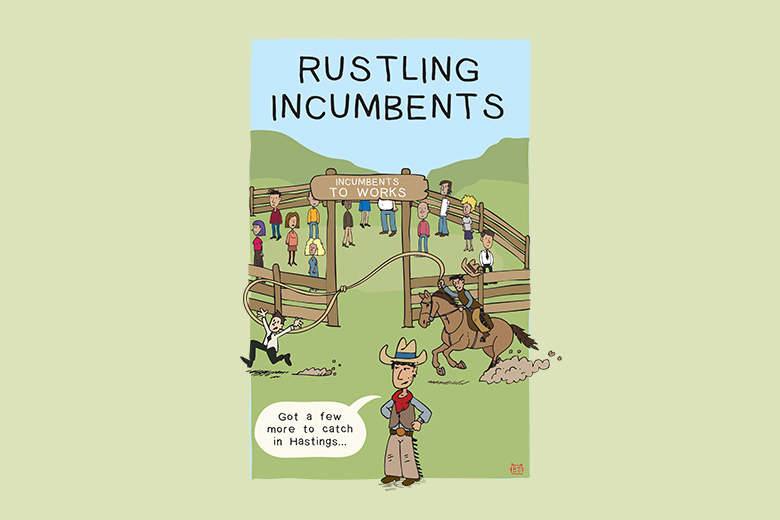
As you are reading this article, candidates for this year’s local body elections have begun to identify themselves officially. The nomination window closes 31 July.
It takes a fair amount of courage to stand in the current environment, especially if one is an incumbent councillor or mayor.
This last class, elected in October 2022, was quickly dealt the catastrophe of Cyclone Gabrielle in February 2023, leaving devastation still being addressed, whether to public infrastructure (roads, bridges, stopbanks, lifeline facilities) or to private lives and businesses (forced relocation, flood damage, income and revenue loss).
It’s no surprise then that voters are especially grumpy, and many will use their October vote to express their unhappiness with councils in general and incumbent councillors in particular, whether fairly or not.
This article documents the level of unhappiness, but also looks into the matter of ‘blame’ and the credibility of would-be saviours.
Voter mood
BayBuzz conducted an online poll over the month of June to get a sense of current attitudes toward our councils. Promoted via our weekly e-newsletter and Facebook page, we received over 450 responses from an audience that – I think it’s fair to say – is more attentive to and informed about local issues and councils than most of the public. A generally reasonable lot.
Our respondents skew 50-plus in age and most have lived in Hawke’s Bay ten years or more. Admittedly not a random sample, but definitely likely voters and canaries in the mineshaft.
Their state of agitation is remarkable (and especially revealed in the tone of verbatim comments many respondents volunteered). Only slightly more calm than the rather hostile commentary by HB’s social media denizens.
For starters, we asked:

This is not a picture of contentment! About a quarter are downright angry, with nearly half frustrated and disappointed. And really nothing to offset that on the positive side, the best adjective being ‘hopeful’, selected by two in ten respondents.
The BayBuzz universe certainly includes some chronic critics of council performance, but really, in my experience, is not a herd of malcontents. Yet this is the tip of an iceberg.
The Regional Council fared slightly better in this survey, but only slightly. Hastings residents were more critical of HBRC than Napier residents, possibly reflecting the Hastings community’s greater engagement with HBRC around contentious issues like water allocation and greater cyclone disruption.

More specifically, we asked about two complaints that come up regularly in residents’ criticism in the media, café conversations, and the posted comments BayBuzz receives.

Clearly respondents believe councils are out of touch – 68% of Napier residents say NCC is not in tune, 62% of Hastings residents say their council is not in synch, and 54% of all respondents say HBRC is not in tune. Only HDC musters 25% in tune. And of interest, 30% are ambivalent about the Regional Council’s priorities, reflecting longstanding confusion about what that council does.
How could there be such a glaring mismatch? I’ll come back to this in a moment.

For both HDC and NCC, fewer than three of ten respondents say they trust their council to do the right thing. Are councils doing the ‘wrong’ things (as suggested by response to the previous question – e.g., spending money on ‘baubles’) or are they just perceived to be bungling appropriate things they should be doing (e.g., clearing streams, fixing potholes)?
In either case, no vote of confidence! A fair call?
Sack ‘em all!
We’d like to think that the upcoming local elections are about choosing the best possible candidates to make difficult choices about public issues that affect all of us. But this requires informed consideration of both issues and people.
Unfortunately, given the public mood, the elections will be more about assigning blame.
I say ‘unfortunately’ for a number of reasons.
First, survey upon survey in New Zealand and elsewhere reflect a steep decline in public trust in institutions of every kind – governments, churches, media, business … all traditional sources of authority. This isn’t the place to examine that phenomenon, but it should be noted that none of our candidates – and especially those currently in power – are invulnerable to this profound baseline distrust.
Second, blame will be poorly assigned. When a council is perceived to screw up something or not listen, who is at fault? Councils make virtually all of their decisions collectively – when do you ever hear of a ‘dramatic close vote’ that decided to proceed with (or kill) policy or project X?! There’s no individual accountability amongst ‘rank and file’ councillors. When was the last time you heard of a councillor storming out of a meeting and denouncing ‘that’s the worst decision this council has ever made and here’s why’!
So if you think your council hasn’t been listening or isn’t in tune with your priorities, all you can do is vote against the whole lot of them … except of course for your old school mate or cousin, who gets a free pass.
And while you’re at it, you can protest vote against your current mayor if you live in CHB, Napier or Wairoa. They were in charge and personally responsible for all the mess-ups, including the cyclone.
Third, remember the cyclone. For sure, councils can’t blame every problem on that disruption. They were capable of dumb decisions before and after, so it’s fine to identify and criticise those. But don’t blame them for spending money on fixing our roads and bridges and augmenting our civil defence capabilities.
Fourth, consider the past. Decisions to neglect water infrastructure were made for decades prior to today’s crew. Our pipes and pumps didn’t start to fail in November 2022. But only now are councils facing up to the consequences, which include punishing costs that must somehow be met.
As I see it, the deck is stacked against all incumbents seeking re-election this year, whatever their individual merits.
Hopefully voters will be more discriminating as they sort out the dead wood.
Voter responsibility
Which brings up the core point … Who do you vote for? And here the burden of responsibility shifts. After all, it was you who voted in all those ‘idiots’ in 2022 who are now incompetent and don’t listen!
So, what will you do to improve your civic IQ?
Will you do a better, smarter job in 2025 or just throw darts at the board? How will you get informed? Will you do more than read – and believe – candidates’ 150-word profile in your Voter Guide?
Smarter voting implies knowing something about the issues, not just the candidates’ bland assurances and cute family photos. You don’t need to know everything. On just two or three important issues you really care about, study up enough to detect and challenge candidate bullshit.
That’s the critical step to better local representation.
Nowhere will this be more important than in assessing candidate claims and promises about rates. The nonsense is already happening, even before most candidates have declared.
‘My highest priority will be to get rates under control.’ That’s it? Not getting my vote.
‘I promise to eliminate waste.’ OK, who are you going to fire? Would you reduce the number of councillors? How about fewer councils? Now you have my attention.
‘I promise to spend only on core services.’ OK, that’s a bit more specific. But which are the ‘un-core’ activities you deem superfluous? How big a part of the council’s current spend are those ‘un-core’ services?
‘I promise to cap council rates at the inflation rate.’ OK, but firstly, some of councils’ biggest costs – e.g., roading materials, insurance, interest rates – outpace consumer inflation. Other core services expand as population increases. Other services, like longer library hours, expand precisely because councillors listen to citizen demands. How would you offset all those increases? Your cut is someone else’s sacred cow.
In none of the rates debate over the coming months are you likely to hear reference to the fact that everyone who has actually studied council rates across New Zealand has come to the same conclusion … the whole framework for paying for local government is broken and unsustainable.
The bottom line is that our councils need a more robust funding toolkit, they need more funding from central government (especially for national scale problems like coastal hazard protection, civil defence, legacy infrastructure catch-up), and they need to look at more ‘radical’ regional consolidation. Let’s see candidates who ‘get’ that as opposed to knee-jerk ‘rates saviours’.
BayBuzz will do its best over the coming months to cut through the candidate haze.
This will include our own candidate surveys, asking candidates to front up clearly on both cross-cutting issues like regional growth, water services & security, Māori wards, and council-specific issues and priorities. We’ll publish candidates’ responses to the surveys of other community groups. We’ll explain the issues in contention. And given sensitivity over rates, we will be looking at rating the candidates on their rates claims, not in terms of agreeing/disagreeing, but with respect to specificity.
Some of this we’ll present in our September/October magazine. But given the pace of the campaign and the number of candidates, much more will be delivered in our online reporting, so please tune in to that.
All of our campaign coverage and issues analysis will live on our website’s Election Central 2025 domain: baybuzz.co.nz/2025- hb-local-council-elections

great summation Tom. i’m personally toying with the idea of running for something just to be a “truth candidate” who exposes others’ bullshit. i wouldn’t expect to be elected, because voters don’t actually want the truth (and won’t vote for it) but, y’know, sometimes the itch needs scratching. ;)
Go for it Bruce!! I’ve had the same feeling. The Truth Ticket!
Brilliant comment Tom: “After all, it was you who voted in all those ‘idiots’ in 2022 who are now incompetent and don’t listen!”
Great article – lots of excellent comment and plenty of sweeping away of the rote claims by candidates. It all comes down to the fact that the voters will blame the councilors – but the voters put them there – so who is really to blame – don’t research the candidates and suffer the consequences – research them and, good or bad, at least you’ve put up the best options (assuming you vote with head and not heart)