


A small number of people own and control commercial property in Hawke’s Bay. Their choices in design and build impact the visual environment. Their success in attracting and maintaining tenants can determine the vibrancy of a whole block. Their neglect of property maintenance, and uncaring for tenant’s wellbeing, can seriously impact lives.
Who’s who
To confirm who’s who in Hawke’s Bay I meet a real estate agent friend for coffee at Albion Canteen in Napier. Cappuccino and flat white.
Perfect place he agrees. The cafe is on the ground floor of an office building constructed by Wallace Development Company Limited (WDCL) in 2013. Across the road is another of their builds. IRD is anchor tenant, along with Tremains and Macpac.
Nodding to the South my agent friend says WDCL are pouring a lot into the refit of Dalton Vautier House. He suggests it’s a good example of why they are so successful.
He’s pretty sure WDCL are the biggest commercial property developers in Hawke’s Bay.
Take the Expressway to Hastings you pass the Kmart complex. Shop at Queen Street Countdown, now Woolworths, or Farmers? And WDCL is lead partner in the Mission Hills subdivision, and my agent friend reminds me they’re building new offices for Bayleys Real Estate in Havelock North. Don’t forget the Quest Hotels. Hastings Quest was delivered in 2023 and Havelock’s is on the way. And there’s the Tech Collective in Ahuriri, to name just a few.
WDCL’s owner and sole director is Jonathan Wallace.
Who’s next?
My agent friend reckons David Mackersey. He owns half of Havelock, the Cinema Gold block in Joll Road, Village Court, the shops and offices wrapping Napier Road down Havelock Road to the service station. And across the road, the Mackersey family in partnership with the Lowe family own the whole block of retail and offices and Porters Hotel. The restaurant’s name Malo recognises the relationship. In Napier Mackersey developed The Crown and Navigate Hotels complex of accommodation, retail, and offices, and Globe Theatre. His latest project, his biggest so far, and nearing completion, is Customs Quay, a collection of shops, offices and apartments on the prime harbour site in Ahuriri.
Any others in that league?
Hard to beat them.
Though two developers doing big things in different ways are Simon Tremain and Michael Whittaker.
Whittaker has transformed Heretaunga Street East since buying the now demolished Albert Hotel in 2014. Matangi beef butchery is the latest outlet joining Ya Bon, Sazio, and Bambini. Currently being re-purposed is the old Billys Bar block, and across the railway line he’s refurbishing Hastings’ highest office building, built in 1984 by David Mackersey’s father for Eastern and Central Savings Bank, who later merged with Westpac.
Of concern, same with developments in Havelock and Napier, is how the low revenue ‘labour of love’ specialist shops can survive in the gentrified hospitality zones. Many, be they selling clothing, antiques, or books, can’t afford the redeveloped rents.
Most relevant about Simon Tremain is his partnership with Cam Ward in forming TW Construction. They’ve formed a company with every element of specialist trades associated with building and development under one roof. They’ve grown really big really quickly. You see their vans, utes, now trucks, everywhere. And they’re building a massive new headquarters in Onekawa.
Importantly, in Havelock North, Simon Tremain and partners own the whole block of Te Mata Road shops from St Lukes to Joll Road tenanted by Westpac, Wardini, Paper Plus and others. Future plans are demolition and rebuild with ground floor retail, upper floor offices and apartments. The design will impact massively on the look of Havelock North.
Who else?
My agent friend says Warren Ladbrook. He’s developed property in Auckland, TaupŌ, and Hawke’s Bay. He’s supervising the Joll Road build for Jonathan and Cristina McHardy.
Any others?
Hansens, he says, Rob and Barb, who developed the Tribune Precinct from the bones of the old Herald Tribune buildings in Hastings.
Tribune
The Hansen family were holidaying in Vietnam when Rob got the call saying others were interested in the old HB Today premises. If they wanted it they should make a move. Quickly. “I worked into the night” shaping an offer. This was September 2018.
In 2013 HB Today had relocated to the old Hawke’s Bay Power Board building in Heretaunga Street, repurposed for them by WDCL, who also transformed the nearby 1912 Power Board building on Eastbourne Street into Opera Kitchen.
The site HB Today abandoned was where the Hawke’s Bay Tribune began in 1911. Amalgamating with its competitor the Hawke’s Bay Herald in 1937, the Herald-Tribune produced an evening newspaper uninterrupted until 1999 when it merged with Napier’s Daily Telegraph, rebranding as HB Today.
The 1911 corner frontage is a rare example of Edwardian architecture to survive the 1931 earthquake.
In the Hansen rebuild the first floor was demolished and the interior gutted so all that remained were the exterior walls, requiring steel bracing reinforced with roof beams. The result is preservation of heritage appearance coupled with current needs, a large open space supporting showroom and cafe.
The space is occupied by Kindred Road. A bit freaky is that two of owner Alice Sip’s great-grandfathers worked at the Hawke’s Bay Tribune a hundred years ago.
That fits with the Tribune Precinct vibe, part synchronicity, mostly design.
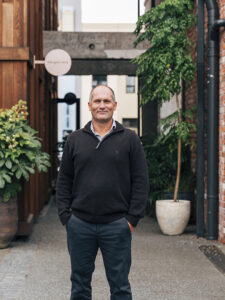
I coffee with Barb and Rob Hansen in the landscaped courtyard linking ground floor hospitality tenants, Kindred Road, Brave Brewers, OMGoodness, Tu Meke Don. In the centre is Atrium, a large open space available for functions. Enormous roller doors were imported from Denmark. An elegant spiral staircase leads to upper floor offices.
A major undertaking was partial demolition of a 1960s four story office building. The top two floors were removed, skeletal reinforced concrete pillars and beams on the lower levels remain, cracked in places with steel exposed.
Distressed meets modern is most visible in hairdresser Morgan Lane. Barb tells how they secured the tenancy. “Friends had their hair done by Josh at Fergus George in Napier, so I went over and asked him if he’d think about coming to Hastings. Josh is so cool. He said, yeah.”
Morgan Lane fit-out was designed by James Davy. “We realised how talented he was,” and “he’s been super involved, helping with other fit-outs, designing the gardens,” and Rob points to big metal gates. “James designed them. See the pattern. He’s replicated the (sawtooth) gable roof look.”
Another tenant enticed to Tribune by Barb is Te Muke Don. “Gemma from Brave told me they had a cult following in Napier.”
I was one of Tim and Junko Karauria’s followers often enjoying their superb Karaage chicken and carefully constructed sushi. Their outlet was in the inner courtyard of Ocean Boulevard which lost more and more tenants over the years from maintenance neglect.
Barb says, “I went over, had sushi and started talking to Tim and Junko. I asked, what about coming to Hastings? They were like, no way. It took me a year to persuade them.”
Attracting complimentary tenants, twenty-eight in total, and creating atmosphere is a developer’s skill the Hansen’s have well achieved with Tribune.
Joll Road
I meet Warren Ladbrook at 8.30am on a Tuesday in Workroom, the minimal industrial style cafe in the Joll Road hospitality cluster. Two flat whites.
I googled him, as you do. He’s a lawyer with pages and pages of director/ shareholder entries on the Companies Office register.
“I’ve been a trustee on many companies; most of them are now deregistered.”
And Google tells me he was involved in the Nelson Park mega-store development in Hastings at one stage, describing Council’s shop size rules as “pre-historic”.
“We picked up the residual land post GFC” and built new for “Noel Leeming, Petstock, Briscoes, Rebel.”
Relocating tenants requires deft negotiation, and along with ability to change course, are major skills of successful developers. “We bought the old Briscoes and Rebel buildings,” on the corner of Heretaunga and Hastings streets opposite New World. “We were trying to get Countdown to do a new supermarket. They were too slow. They came back to us, but it was too late.”
Instead, “City Fitness went into the old Rebel, and Briscoes went to MTG.” Later council bought the City Fitness building, future proofing the cultural zone linkages. As for Briscoes? “We thought it was for MTG storage, and offered to upgrade, but it went to a whole different level.”
Architects for the MTG build are RTA Studio, Auckland headquartered, now with an office in Joll Road. They’ve been busy with projects at Woodford House, the Food Hub in Tomoana Road, Tribune, and Mackersey’s Custom Quay in Ahuriri.
Founder of RTA is Richard Naish, old friend of Warren Ladbrook. “We flatted together in London.” He introduced RTA to Joll Road investor, Jonathan McHardy. “I met Jonathan and offered to give them a hand.”
Andy Coltart was originally involved, but “he sold to concentrate on the bigger and better things he was doing in the Valley.”
The brief to RTA was to “shake the tree a little bit and see what could be done for The Village.”

The result is imposing. Road view is four tall thin three-story structures, three pitched roofs, one flat. Facia signage is Craigs, Colliers, Alma, Forsyth Barr. Ground level are restaurants and bars, upper floors are offices.
Architect’s notes say the design employs the typology of the barn with a contemporary twist.
“We originally thought of cladding in ship lap vertical timber, like Andy Coltart’s barn style, to have this gradual change from rural to village, but that was just after Grenfell Tower fire in London.” Regulations changed in response, “so we couldn’t use timber cladding over two levels.”
Are fire regulations really that strict?
“They’re an absolute regime of terror. Don’t get me started.” He has already. “Fire rules are so complicated they’re impossible to understand.” He points to exposed steel beams. “They required three coats of intumescent paint which is so heavy it strips itself. It’s meant to stand for 90 minutes in a fire. What do you do when there’s a fire? Wait to finish your coffee because you’ve got 90 minutes? Why 90? Why not 30?” He’s asked fire engineers to explain the reasoning, “but they can’t. It’s made-up science.”
Is it the same with earthquake codes?
“That’s another regime of terror. Earthquake rules are destroying heritage in New Zealand. Every time there’s a major earthquake they change the rules.” He tells me even though the land beneath us is “some of the most stable in Hawke’s Bay,” the earthquake engineering is way over prescribed. “There’s a kilometre of concrete and steel under this building. It’s crazy.”
In case readers think Warren Ladbrook’s opinion of earthquake and fire regulations are over the top. They’re not.
When I passed on Warren’s term “regime of terror” to Jonathan Wallace, he said, “totally agree,” adding rules were so strict new builds shouldn’t have to pay the Fire and Emergency levy.
WDCL
I had messaged Jonathan Wallace asking for an interview. He replied. “I’m not particularly interested in featuring personally, but it could be okay for WDCL. Perhaps we could have a preliminary chat?”
We meet at Hawthorne in Havelock North. Two flat whites. WDLC head office is next door. Unsurprisingly he owns most of the block. He’s working on how to redevelop the area. Planning is in the early stages. Something about using timber. We talk about excessive earthquake compliance, climate change, the effect of a tsunami on Napier, Havelock’s awful architecture, Donald Trump, and vehicle access on Waimārama beach. Without recording or notes, I can’t remember in which order. He agrees to an interview.
In the meantime, I meet Ryan Schnell at Raffles Cafe. His coffee is Americano. South African accent. I have to ask. “Kiwi Mum,” he says. “Mostly educated in New Zealand.” He’s WDCL Development Manager/Facilitator.
Noise from construction next door makes hearing testing at times. A 1960s build for solicitors Langley Twigg and Doole is stripped to a skeleton and being recreated as apartments. The developer has a reputation. I tell Ryan it wouldn’t be smart to buy off plans. He’s too circumspect to comment.
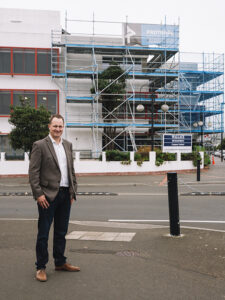
I’m interested to hear about Dalton Vautier House. We can see its enormous bulk across the road partially wrapped in scaffolding. Built by the Ministry of Works in 1984, it was their last construction in Hawke’s Bay before state sector reforms saw contracting out of Government property needs to the private sector.
“Our strategy at present is around acquiring existing assets.” Reasons include, “the sheer cost of current building, and the sustainability factor of imbedded carbon within existing buildings.” Smart to consolidate existing building stock, environmental plus, and can be bigger bang for the buck than building new.
WDCL keeps a sharp eye on properties “where an owner doesn’t keep up with repairs and maintenance. They can’t attract tenants because of the quality of the asset, and the building loses value.”
Dalton Vautier is a good example. So too is nearby Ocean Boulevard, owned by absentee landlords, allowed to deteriorate, with many vacant shops. Of course WDCL are interested, as others are, but the asking price is too high. Patience. “I know Jonathan waited a long time before making the successful offer here.”
A great advantage of Dalton Vautier is, “there’s no asbestos and it’s 100% of earthquake code.” And an interesting aspect of the renovation is the enclosing of over 1000 square metres of balconies making a total of 8400 square metres of lettable area, more than Tribune and Joll Road developments combined. We assume “the balconies were for smokers,” and share memory of international air travel in the 1980s when the back rows of planes had dedicated smoking seats.
Dalton Vautier House is nearly fully let with some prime tenants on long term leases.
The Boss
When next I meet Jonathan Wallace, my iPhone Voice is on. I ask him. How did it all start? He’s developed over 400 commercial properties and he’s on the NBR Rich List.
He says he was brought up with the expectation he would own a business. “My father owned a trucking business.” He could have taken over, “but to me it wasn’t a good business model at all. You’re dealing with small accounts, with unreliable workers, and trucks are depreciating assets.”
At Massey he studied accounting and finance. “Looking back, my peers expected to get a job, I knew I wanted to own my own business.” And he knew he wanted that business “to have some scale with appreciating assets.” Real estate was the perfect fit. “Naively I stumbled into buying three houses, borrowing and scrounging money where I could and by the end of twelve months did quite well.” But residential real estate didn’t appeal. “I’d just end up owning a whole lot of shoddy houses.” Scale was in commercial. “I bought a factory warehouse,” in Whanganui developing it into small units. This was 1983.
So how did he structure his business?
“I’ve always run two companies, an asset holding company which owns and manages rental properties, and a development company building new or refurbishing, keeping some properties as income assets, selling as required to release capital for new projects. Fundamentally that model hasn’t changed for forty odd years.”
What makes him so successful? He has many repeat clients with multiple builds for Quest hotels, ASB bank, BP, Government Departments and more.
“The first one takes ages because there’s no trust in the room. You haven’t got a relationship. You have to rely on documentation because the people we’re dealing with don’t want to make a mistake. They’re terrified of getting fired so everything’s checked, checked and rechecked.”
So trust is key?
“There’s a contract. Once we’ve done one and delivered, in the future they’re more likely to deal with us, because they know we do what we say we are going to do.”
An advantage is much of the building specifications, documentation, and legality is tweak and repeat. “Just change the address and the lease specifics to the job.”
He makes it sound simple. It’s not. There’s considerable risk. Many have tried and failed.
“There’ve been two huge down cycles since I’ve been in the business. At least eighty percent of my competitors got wiped out in the ’87 crash, same with the GFC of 2008.”
How about the current economic situation?
“I knew a downturn was coming, I just didn’t know when. It’s certainly a moderate downturn so far and I don’t know where it ends to be honest. My job is to manage the risk. In good times you don’t have to be very smart. You just have to own something. Everything goes up. The tide rises for everyone. It’s easy. It’s the bad times when people get cleaned out.”
How does he manage the risk when he sees bad times coming?
“We get rid of properties that aren’t matched with revenue. We stress test our tenants and try and get rid of the ones that I don’t think are going to last. Some tenants will survive anything, like government departments and banks, then there are ones that struggle in the middle, then there are ones that clearly won’t last. We lock in our funding at cheapest rates so we’re not vulnerable to that.”
What does he think has caused the downturn? Australia and the US aren’t so stressed.
“We put far too much cheap money into the economy.”
Government’s Covid response? Printing virtual money by borrowing cheap?
“It started before Covid. Borrowing was as low as 2.8%, now it’s around 7.5%. What that does is change (decrease) the value of property which is based on the capitalisation rate.”
I checked. The Official Cash Rate in December 2016 was 1.75%. Previous National Government. Today it’s 5.5%.
“If you’ve got debt the difference can put you outside the banking covenants.”
Bank covenants are twofold when lending on commercial property. One is loan to value ratio, generally around 50:50, and the other is rental income being at least double the interest paid on the loan. Decrease in property value and loss of tenants will see some commercial property owners fail banking requirements.
“Scale is not a fortress,” says Jonathan Wallace. He’s done as much as he can to mitigate the effects of the downturn on WDCL.
Obvious toughness is required. I have to ask. You don’t get to be a mega wealthy developer by being kind, do you?
“No, hey.” He’s firm. “I don’t agree with that.” And he tells me the attitude of a property owner ‘lording’ it over tenant has changed dramatically. “We have a tenant first approach. In my mind it’s the person who pays the money who should have the power. Simplistically we look after the people who pay us money (tenants) and we’re civil to people we pay money to, but we don’t have to look after them.”
So how does he treat a tenant whose business fails two years into a ten year lease?
“First thing to remember, there’s a contract. We’ve had many cases where we’ve let tenants off. We don’t want to ruin people’s lives. But if they’re belligerent, got attitude, or a Corporate, we’ll keep them to contract. We’ve both signed the same bit of paper and agreed.”
And he points out it’s more likely IRD and trade creditors will take a failed business to liquidation before the property owner.
An exciting development in Jonathan Wallace’s business career is his partnership with son Tom in Re-Leased, a commercial property management software company with over 1300 clients, supported by over 170 employees in NZ, Australia, USA, and UK.
Who’s idea was it?
He laughs. “We argue about who had the idea first. We both claim it.” He credits Tom with seeking the help of Xero accounting software founder Rod Drury. “He had a beach place near ours and was very generous with his knowledge and time.”
He says Re-Leased “has been a difficult but a rewarding journey. So different than my day job.” And he reflects. “In Dad’s generation business was people intensive. In mine it’s been about building capital assets.” But with Re-Leased, “Your dealing with a product, software, you can’t see.” Wealth without real estate.
“It’s been refreshing for me seeing how you can do business in this brave new world.”
I message Jonathan Wallace to arrange a photograph. He declines.
